
The #1 Reason Students Score Below Their Potential on the DAT
It's not intelligence. It's not even the amount of time they studied.
It's the absence of a structured plan.
Every year I see the same pattern: a pre-dental student spends 3 months studying, puts in 6–8 hours a day, works through entire textbooks — and still walks away with a 17 or 18. Then another student studies smarter over 10 focused weeks, follows a deliberate schedule, and hits a 22.
The difference isn't effort. It's strategy.
This guide is everything I wish someone had handed me when I started DAT prep. It covers how to build your DAT study schedule from scratch, how to approach each section of the exam, which resources are actually worth your time, and what the highest scorers do differently that most students never figure out.
Understanding the DAT Before You Study for It
Before you write a single study session on your calendar, you need to understand exactly what you're preparing for.
The Dental Admission Test has four scored sections:
| Section | Topics Covered | # of Questions | Time |
|---|---|---|---|
| Survey of Natural Sciences | Biology, General Chemistry, Organic Chemistry | 100 | 90 min |
| Perceptual Ability Test (PAT) | Spatial reasoning, hole punching, angle ranking, cube counting | 90 | 60 min |
| Reading Comprehension | Three science passages with questions | 50 | 60 min |
| Quantitative Reasoning | Math, algebra, probability, data analysis | 40 | 45 min |
The Academic Average (AA) is calculated from all four sections. Most competitive dental schools want a 19–20+ AA, with top programs expecting 21–23.
The most important thing to understand: Biology, General Chemistry, and Organic Chemistry together make up 100 questions — that's the largest single block of the exam. PAT is entirely unique and most students underestimate how much time it takes to build those visual skills. These two areas deserve the most attention in your schedule.
Step 1 — Take a Diagnostic Test First
Before scheduling a single study session, take a full-length practice test under real timed conditions.
This is non-negotiable.
Your diagnostic score tells you:
- Your starting point in each section
- Which subjects are your strengths vs. weaknesses
- How your time management holds up under pressure
Without a diagnostic, you're building a plan based on assumptions. With it, you're building a plan based on data.
Where to take your diagnostic: DAT Bootcamp, DAT Destroyer, or Crack DAT PAT all offer free or trial access. Use one of these rather than a random practice test from a blog. The difficulty calibration matters.
Once you have your diagnostic scores, rank your sections from weakest to strongest. This ranking directly determines how you allocate study time.
Step 2 — Choose Your Study Window
How long should you study for the DAT?
This is one of the most common questions I get, and the honest answer is: it depends on your starting point. Here's a general framework:
| Starting Diagnostic AA | Recommended Study Time |
|---|---|
| 14–16 | 14–18 weeks |
| 17–18 | 10–12 weeks |
| 19–20 | 8–10 weeks |
| 20+ | 6–8 weeks (refinement) |
Most students see the best results with 10–12 weeks — enough time to build real competency without burning out or forgetting early material before test day.
Common Mistakes With Study Timeline
Studying too long: If you stretch prep to 5–6 months without a structured plan, you'll forget early material before you need it and hit motivational burnout by week 8. Intensity beats duration every time.
Studying too short: Cramming 6 weeks of prep for a 10-week gap costs you points. You can't build PAT skills in two weeks — it takes consistent daily practice over 8–10 weeks to genuinely improve. For drills by question type, use our DAT spatial reasoning practice guide.
Scheduling your test date: Once you have a study window, schedule your actual test date before you start prep. A fixed deadline creates the urgency that turns good intentions into consistent work.
Step 3 — The Proven DAT Study Schedule Structure
Here's how to structure your study weeks for maximum efficiency.
Phase 1: Content Building (Weeks 1–6)
The first half of your prep is about learning and reviewing core content. You're not drilling questions yet — you're building the knowledge base.
Daily structure (4–6 hours/day):
- 2 hours: Primary weak section (biology, gen chem, or orgo depending on your diagnostic)
- 1.5 hours: PAT practice (every single day — this is non-negotiable)
- 1 hour: Secondary content review
- 30 min: End-of-day review notes / mistake log
Week-by-week focus:
Week 1–2 — Biology Foundation
Cover cell biology, genetics, evolution, and diversity of life. Biology has the most raw content on the DAT and can't be rushed. Use Feralis Biology Notes (free, comprehensive) as your primary reference. Cross-reference with your prep course for high-yield topics.
Week 3–4 — General Chemistry
Focus on stoichiometry, periodic trends, acid-base chemistry, thermodynamics, and electrochemistry. These are the highest-yield gen chem topics. Work through concept explanations first, then do 15–20 practice questions per topic before moving on.
Week 5–6 — Organic Chemistry
Orgo on the DAT is heavily mechanism and reaction-based. You don't need to know obscure named reactions — you need to master the core mechanisms (nucleophilic substitution, addition, elimination, oxidation/reduction) and recognize functional group transformations. Chad's Organic Chemistry videos are widely considered the best free resource for DAT orgo.
PAT — Every Day From Day 1
This is the section most students neglect until the last month — and it shows in their scores. PAT skills are built through repetition over time, not cramming. Spend 45–60 minutes on PAT every single day throughout your entire prep. Rotate through question types: keyhole, top-front-end, angle ranking, hole punching, cube counting, pattern folding.
Phase 2: Practice and Application (Weeks 7–10)
Content review is done. Now you apply it under pressure.
Daily structure (5–7 hours/day):
- 2 hours: Full section timed practice (rotate through SNS, PAT, RC, QR)
- 1.5 hours: Detailed error analysis (every wrong answer)
- 1 hour: High-yield content review based on error patterns
- 30 min: PAT targeted practice
- 30 min: Reading Comprehension passage
Error analysis is where real improvement happens. For every question you get wrong, write down: 1. The specific topic it tested 2. Why you got it wrong (knowledge gap vs. misread vs. time pressure) 3. The correct reasoning, in your own words
After two weeks of this, you'll see clear patterns in your mistakes. Those patterns tell you exactly where to focus your remaining time.
Phase 3: Full-Length Tests and Refinement (Weeks 11–12)
This phase is about building test-day stamina and dialing in your timing strategy.
Schedule:
- Take a full-length practice test every 3 days
- After each test: score it, do a full error analysis, identify the 3 biggest issues to address before the next test
- Between tests: targeted review of those 3 issues only
- Do not start any new content at this stage
Full-length tests to use: DAT Bootcamp full-lengths are widely considered the gold standard for difficulty calibration. ADA's official practice tests are also essential. By test day, you should have completed at least 4–5 full-length timed exams.
Section-by-Section Strategy
Biology — Build a System, Not a Memory Dump
Biology is 40 questions out of 100 in the SNS section. It's the highest-yield single subject on the DAT.
The mistake most students make: trying to memorize every biological fact. The DAT doesn't test encyclopedic knowledge — it tests your ability to apply concepts.
High-yield biology topics to master:
- Cell biology (organelles, membrane transport, cell cycle, mitosis/meiosis)
- Molecular biology (DNA replication, transcription, translation, mutations)
- Genetics (Mendelian genetics, Hardy-Weinberg, pedigree analysis)
- Evolution (natural selection, speciation, phylogenetics)
- Ecology (population dynamics, nutrient cycles)
- Diversity of life (classification, characteristics of major taxa)
Best resources: Feralis Biology Notes + DAT Bootcamp biology question bank. Use the notes for content, use the question bank to test application. Don't use a standard AP Bio textbook — too much irrelevant detail.
General Chemistry — Understand the Concepts, Not Just the Formulas
Gen chem is 30 questions in the SNS. Students who memorize formulas without understanding the underlying concepts consistently underperform here.
High-yield gen chem topics:
- Stoichiometry and limiting reagents
- Atomic structure and periodic trends
- Bonding (Lewis structures, VSEPR, hybridization)
- Thermochemistry and thermodynamics
- Equilibrium and Le Chatelier's principle
- Acids and bases (pH, buffers, titrations)
- Electrochemistry (galvanic cells, electrolysis)
- Kinetics
Strategy: For every gen chem topic, do this: read the concept, solve 5 practice problems, explain the concept out loud without notes, then solve 5 more problems. If you can teach it, you know it.
Organic Chemistry — Mechanisms Over Memorization
Orgo is 30 questions in the SNS and terrifies most pre-dental students. Here's the truth: DAT orgo is much more manageable than your orgo course. The test focuses on reactions and mechanisms, not synthesis pathways or advanced spectroscopy.
High-yield orgo topics:
- Substitution reactions (SN1 vs. SN2 — conditions, stereochemistry, leaving groups)
- Elimination reactions (E1 vs. E2)
- Addition reactions (Markovnikov, anti-Markovnikov, hydrogenation)
- Carbonyl chemistry (aldehydes, ketones, carboxylic acids, esters)
- Aromatic chemistry (electrophilic aromatic substitution)
- Functional group identification and transformations
Best resource: Chad's Organic Chemistry videos on YouTube — free, clear, DAT-focused. Watch the video, take notes, immediately do 10–15 practice questions on that topic before moving to the next one.
PAT — The Section That Rewards Consistency
The Perceptual Ability Test is unlike anything else on the exam. It tests 3D visualization, pattern recognition, and visual problem-solving. You either build these skills through consistent daily practice — or you don't. For targeted drills, see our DAT spatial reasoning practice guide.
The 6 PAT question types:
- 1Keyhole — Which hole does a 3D object fit through?
- 2Top-Front-End — Given two views, identify the third
- 3Angle Ranking — Rank 4 angles from smallest to largest
- 4Hole Punching — Predict where holes appear when a folded paper is punched
- 5Cube Counting — Count cubes with a specific number of painted sides
- 6Pattern Folding — Fold a 2D pattern into a 3D shape
Strategy: Practice every type every day. Don't skip the types you dislike — those are exactly the ones costing you points. Crack DAT PAT and DAT Bootcamp PAT have the best practice banks. Time yourself from day one. Speed matters as much as accuracy here.
Reading Comprehension — It's a Time Management Test
Most students either ace RC naturally or waste 20+ minutes reading passages before answering. The RC section rewards a specific strategy:
Search-and-destroy approach:
- 1Read the questions first (not the passage)
- 2Know what specific information you're looking for
- 3Skim the passage for context, then search for specific answers
- 4If a question requires inference, read only the surrounding 2–3 paragraphs
You do not need to fully comprehend the passage before answering. You need to find information efficiently. Practice this technique on every RC passage you do during prep — don't wait until the last week.
Quantitative Reasoning — Don't Neglect This Section
QR is often treated as an afterthought because it's "just math." But a 17 in QR can drag down your AA significantly. The content is manageable — it's the time pressure that trips students up.
Topics to review: algebra, word problems, probability and statistics, trigonometry, data analysis. The math itself is not advanced, but the questions are worded to create confusion.
Strategy: Do 40 timed QR questions at least twice per week throughout prep. Build the mental habit of working quickly. Use answer elimination on questions where you can quickly rule out 2–3 answers — this alone can save 30–45 seconds per question.
The Best DAT Study Resources
After working with hundreds of DAT students, here are the resources I consistently recommend:
Primary prep course:
- DAT Bootcamp — Best overall resource. High-quality question banks, realistic full-length exams, and a built-in study schedule. Worth the investment.
- DAT Destroyer — Excellent for advanced chemistry practice. Questions are harder than the real exam, which is intentional.
Free resources:
- Feralis Biology Notes — The most comprehensive, DAT-specific biology reference available. Free PDF.
- Chad's Videos (YouTube) — Best free resource for general chemistry and organic chemistry explanations.
- Crack DAT PAT — PAT-specific practice with the most varied question bank.
Official:
- ADA Official DAT Practice Tests — Use these in Phase 3. They give you the most accurate score prediction.
What to avoid: Generic MCAT prep materials (wrong exam, different topics, different difficulty), pre-2018 DAT prep books (the exam format has changed), and any resource that doesn't have a strong track record of recent student reviews.
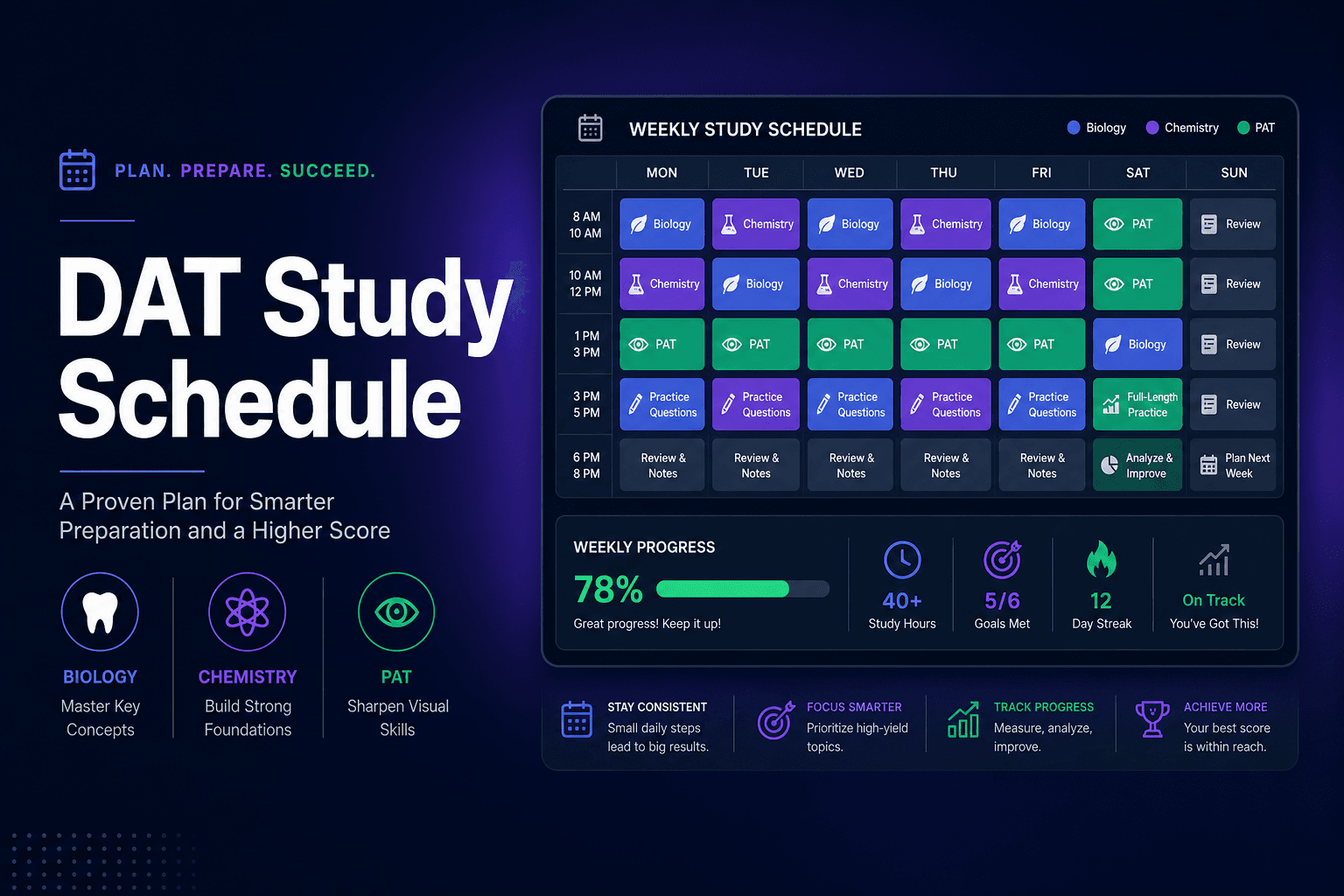
The Weekly Study Schedule Template
Here's a concrete 6-day weekly template for Phase 2 (practice phase):
| Day | Morning (2–3 hrs) | Afternoon (2 hrs) | Evening (1 hr) |
|---|---|---|---|
| Monday | Biology practice + review | PAT (all 6 types) | Error log review |
| Tuesday | Gen Chem practice + review | RC (2 full passages) | Weak topic drill |
| Wednesday | Orgo practice + review | PAT (focused weak type) | Error log review |
| Thursday | Full SNS timed section | QR timed practice | Content review |
| Friday | PAT full timed section | RC full timed section | Weak section review |
| Saturday | Full-length practice test | Full test analysis | Plan next week |
| Sunday | Light review / rest | — | — |
Adjust this template based on your weaknesses. If PAT is your lowest section, add 30 more minutes to every PAT block. If biology is dragging, shift Tuesday morning to biology instead of gen chem.
What High Scorers Do Differently
After coaching students to 22+ scores, I've noticed consistent habits that separate top performers from average ones.
They treat mistakes as data, not failure. Every wrong answer is information. They don't skip past it — they sit with it until they understand exactly why the correct answer is correct and why each wrong answer is wrong.
They practice under real timed conditions from week one. Students who do all their practice untimed build false confidence. They then freeze under real time pressure on test day. Timed practice from day one builds the mental muscle you need.
They don't study content in isolation. They connect topics. Acid-base chemistry connects to buffer systems in biology. Electrochemistry connects to oxidation reactions in orgo. The students who see these connections score higher because they apply one concept to solve problems from multiple angles.
They prioritize sleep over extra study hours. A 7–8 hour sleep night before a practice test is worth more than 2 extra study hours and 5 hours of sleep. Memory consolidation happens during sleep. This isn't a lifestyle suggestion — it's a neuroscience fact that directly affects your test performance.
They get personalized feedback on their mistakes. Self-study can identify that you're getting orgo wrong. A DAT tutor can identify why you're getting orgo wrong — and that distinction is worth several points on your actual score.
FAQ: DAT Study Schedule
Can I study for the DAT while taking classes?
Yes — but reduce your daily study hours accordingly. 2–3 focused hours per day while taking classes is more effective than 4 irregular hours. Extend your total prep window to 14–16 weeks to compensate.
How many hours per day should I study for the DAT?
Phase 1: 4–5 hours/day. Phase 2: 5–7 hours/day. Phase 3: 4–5 hours/day (quality over quantity). More than 8 hours/day consistently leads to diminishing returns and burnout.
Should I study for the DAT on weekends?
Yes, but differently. Use Saturdays for a full-length practice test. Use Sundays for light review and planning your upcoming week. Don't take full days off during active prep — the continuity matters, especially for PAT skills.
What is a good DAT score to aim for?
For most dental schools: 19–20 AA. For competitive programs: 21–22 AA. For top programs (Penn, Harvard, Columbia, UCSF): 22–24 AA. Check the average accepted DAT scores for each school on your list and aim for the 75th percentile of their entering class, not just the average.
Is the real DAT harder than practice tests?
DAT Bootcamp practice tests are calibrated to be approximately the same difficulty as the real exam, sometimes slightly harder. ADA official tests are the closest match. If you're consistently scoring 20–21 on Bootcamp full-lengths, expect a similar result on the real exam.
What if I score below my target on test date?
First: don't retake impulsively. Identify exactly what went wrong (nerves, specific section, time management) and build a targeted plan. Most students who retake within 90 days with a structured plan improve by 2–4 points. Use our full guide Should I Retake the DAT? before you re-register, or contact our team for a free consultation on retake strategy.
Your Next Step
You now have everything you need to build a real DAT study plan — not the generic advice you'll find everywhere, but a section-by-section strategy grounded in what actually moves the needle.
Here's how to start today:
- 1Take a full-length diagnostic test this week
- 2Score it and rank your sections weakest to strongest
- 3Schedule your test date based on the study window framework above
- 4Build your weekly schedule using the Phase 1 template
- 5Get your resources in place before day one
If you want expert support along the way — whether that's a private DAT tutor for your weakest section or a full dental school application strategy — our team is here.
Your target score is achievable. You just needed the right plan.
Written By

Dr. Alexander Takshyn
DMD, Admissions Consultant & Founder