
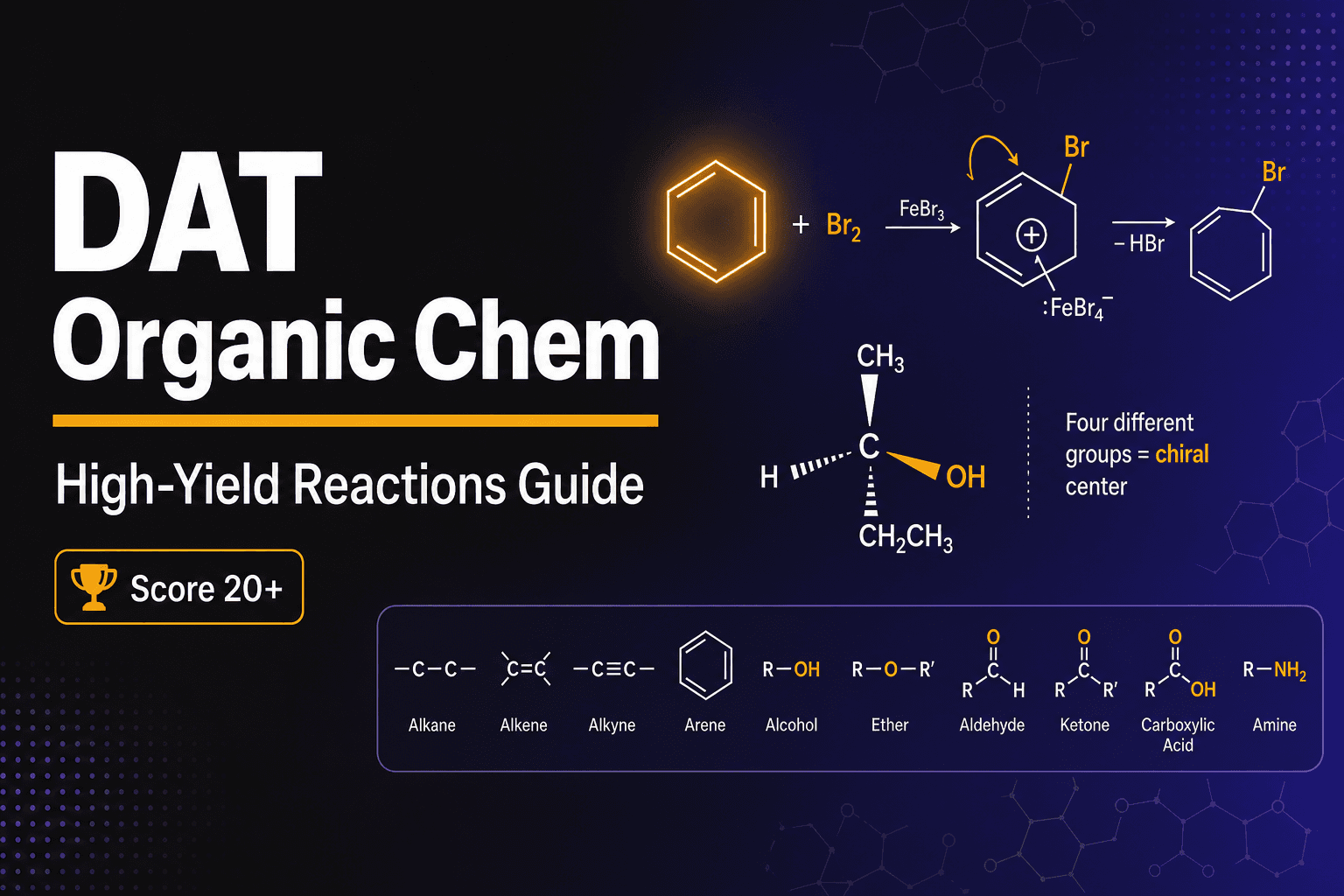
Why DAT Organic Chemistry Feels Harder Than It Is
Organic Chemistry is 30 questions on the Survey of Natural Sciences — the same weight as General Chemistry. But it produces more anxiety than any other section for most pre-dental students. That anxiety is usually not about intelligence. It is about study method.
Students who treat Orgo like a memorization dump of every reaction from Organic Chemistry I and II burn out and still miss questions. Students who treat it like a pattern recognition test — reagents, functional groups, stereochemistry, and a short list of high-yield mechanisms — consistently score 20+.
The DAT does not ask you to invent new chemistry. It asks you to recognize structures, predict products, choose reagents, and apply a limited set of concepts under time pressure. This guide maps those concepts and gives you a study sequence that works.
DAT Organic Chemistry: Format Overview
Questions: 30
Time context: Last section of the 90-minute Survey of Natural Sciences
Typical budget: ~28–32 minutes if Biology and Gen Chem stay on schedule
Question types you will see:
- Predict the product
- Identify the reagent
- Name / classify a structure or functional group
- Stereochemistry (R/S, E/Z, enantiomers, diastereomers, meso)
- Spectroscopy / lab technique (IR, NMR basics, TLC, extraction)
- Mechanism recognition (SN1/SN2, E1/E2, addition, substitution)
Scoring: Scaled 1–30. A 20 is strong. Orgo often decides whether your Total Science clears the competitive range.
High-Yield Content Map
Tier 1: Must-Know Cold
Functional Groups and Nomenclature
- Alkanes, alkenes, alkynes, aromatics
- Alcohols, ethers, epoxides
- Aldehydes, ketones, carboxylic acids, esters, amides, acid chlorides
- Amines and thiols
- IUPAC basics and common names that appear on the DAT
Stereochemistry
- Chirality, enantiomers, diastereomers, meso compounds
- R/S assignment (priority rules)
- E/Z for alkenes
- Optical activity and racemic mixtures
- How stereochemistry changes in SN1 vs. SN2
Substitution and Elimination
- SN1 vs. SN2: substrate, nucleophile, solvent, leaving group
- E1 vs. E2: same decision factors + heat / bulky base
- Zaitsev vs. Hofmann products
- Carbocation rearrangements (hydride / alkyl shifts)
Addition Reactions to Alkenes and Alkynes
- Hydrohalogenation (Markovnikov; peroxide effect for HBr)
- Acid-catalyzed hydration
- Hydroboration-oxidation (anti-Markovnikov)
- Halogenation and halohydrin formation
- Hydrogenation (syn)
- Ozonolysis (know products)
- Epoxidation and dihydroxylation (syn vs. anti)
Aromatic Chemistry
- Benzene stability and aromaticity criteria (Hückel's rule basics)
- Electrophilic aromatic substitution: halogenation, nitration, sulfonation, Friedel-Crafts alkylation/acylation
- Ortho/para vs. meta directors
- Activating vs. deactivating groups
Tier 2: Frequently Tested
Alcohols, Ethers, Epoxides
- Oxidation of alcohols (PCC vs. strong oxidants; primary vs. secondary)
- Conversion of alcohols to alkyl halides / tosylates
- Williamson ether synthesis
- Epoxide opening (acidic vs. basic conditions — regiochemistry)
Aldehydes and Ketones
- Nucleophilic addition (Grignard, hydride reductions)
- Acetal / hemiacetal formation
- Imine and enamine formation
- Aldol condensation (basic idea + product recognition)
- Wittig reaction (product recognition)
Carboxylic Acid Derivatives
- Relative reactivity: acid chloride > anhydride > ester > amide
- Nucleophilic acyl substitution pattern
- Saponification, Fischer esterification
- Amide formation and hydrolysis
Amines
- Basicity trends
- Alkylation and reductive amination
- Diazonium chemistry at a recognition level
Spectroscopy and Lab
- IR: key peaks (O–H, C=O, C≡N / C≡C, C–H)
- 1H NMR: chemical shift regions, integration, splitting (n+1)
- Mass spectrometry basics (molecular ion)
- Extraction, distillation, TLC (polarity and Rf)
Tier 3: Lower Frequency
- Advanced rearrangements beyond common carbocation shifts
- Detailed polymer chemistry
- Exotic named reactions that rarely appear
Master Tier 1 and 2 before spending serious time here.
The Decision Framework That Wins Orgo Points
For substitution/elimination questions, run this checklist every time:
- 1What is the carbon? Methyl / primary / secondary / tertiary
- 2What is the nucleophile or base? Strong or weak? Bulky?
- 3What is the solvent? Polar protic vs. polar aprotic
- 4Heat present? Favors elimination
- 5Leaving group quality?
This five-step habit alone lifts SN1/SN2/E1/E2 accuracy for most students.
For aromatic EAS questions: 1. Identify the existing substituent 2. Decide activating/deactivating 3. Decide ortho/para vs. meta 4. Predict major product(s)
Best Resources for DAT Orgo
1. DAT Booster Organic Chemistry
Best primary practice bank for most applicants. Explanations matter as much as the questions — read every miss.
2. Organic Chemistry as a Second Language (Klein) — selected chapters
Excellent for rebuilding foundations in stereochemistry, substitution/elimination, and carbonyl chemistry if your undergrad Orgo was weak.
3. Reaction summary sheets + Anki
Make (or use) a compact reaction sheet: reagent → transformation. Drill until recognition is instant. Anki for IR peaks, directors, and SN/E rules.
4. Chad's Videos / Organic Chemistry Tutor
Use for stuck topics only — not as your entire curriculum.
5. DAT Destroyer Orgo (for 22+ push)
Harder than the real exam. Use after you are already near 19–20.
Also pair this with our DAT General Chemistry guide and DAT Biology guide so SNS study stays balanced.
4-Week Orgo Study Plan
Week 1: Structure, Stereochemistry, SN/E
- Functional groups + nomenclature daily
- Stereochemistry drills (R/S, meso, optical activity)
- SN1/SN2/E1/E2 until the decision framework is automatic
- 50–70 practice questions
Week 2: Alkenes, Alkynes, Aromatics
- Addition reactions and product prediction
- EAS + directors
- Timed mini-sets every other day
Week 3: Oxygen- and Nitrogen-Containing Compounds
- Alcohols, ethers, epoxides
- Aldehydes/ketones and carboxylic acid derivatives
- Amines basics
- Start spectroscopy/lab mixed questions
Week 4: Mixed Orgo + Full SNS Practice
- 3–4 full Survey of Natural Sciences practice blocks
- Error log only on your bottom topics
- Final days: reaction sheet + spectroscopy peaks + no new reactions
Common Mistakes That Cap Orgo at 16–18
1. Memorizing reactions without conditions
Knowing "HBr adds to alkenes" is not enough. Markovnikov vs. peroxide, rearrangements, and stereochemistry are where the DAT separates scores.
2. Ignoring stereochemistry until the end
Stereochemistry is woven through SN2, additions, and meso questions. Study it early.
3. Skipping spectroscopy because it "feels rare"
A few IR/NMR items are nearly free points if you know the signature peaks and splitting patterns.
4. Studying Orgo when exhausted and never under time
Orgo is last in SNS. Practice it after Bio + Gen Chem blocks, not only fresh in the morning.
5. Collecting more resources instead of drilling misses
One solid Q-bank + a reaction sheet beats five passive video playlists.
How to Know If You Are Ready for 20+
You are close when:
- You can classify SN1/SN2/E1/E2 in under 20 seconds
- You can name the major product of common alkene additions without notes
- You know ortho/para vs. meta directors without hesitation
- Your timed Orgo subsection is stable at 19–21 across multiple practice sets
If you are stuck below that after consistent practice, the issue is almost always a small cluster — stereochemistry, EAS directors, or carbonyl reactivity — not "all of organic chemistry."
For focused help on those weak clusters, schedule a free consultation with Future Dentist Prep. Private DAT tutoring is built exactly for this kind of targeted score recovery.
Written By

Dr. Alexander Takshyn
DMD, Admissions Consultant & Founder