
You Have Two Weeks. Here's How to Use Them.
Most applicants prepare for dental school interviews the wrong way: they spend hours memorizing answers to lists of possible questions, then walk into the interview room and sound exactly like someone who memorized answers to lists of possible questions.
Good interview preparation is not about memorizing. It is about building genuine fluency — the ability to access your own stories, articulate your thinking clearly under pressure, and respond to unexpected follow-ups without freezing.
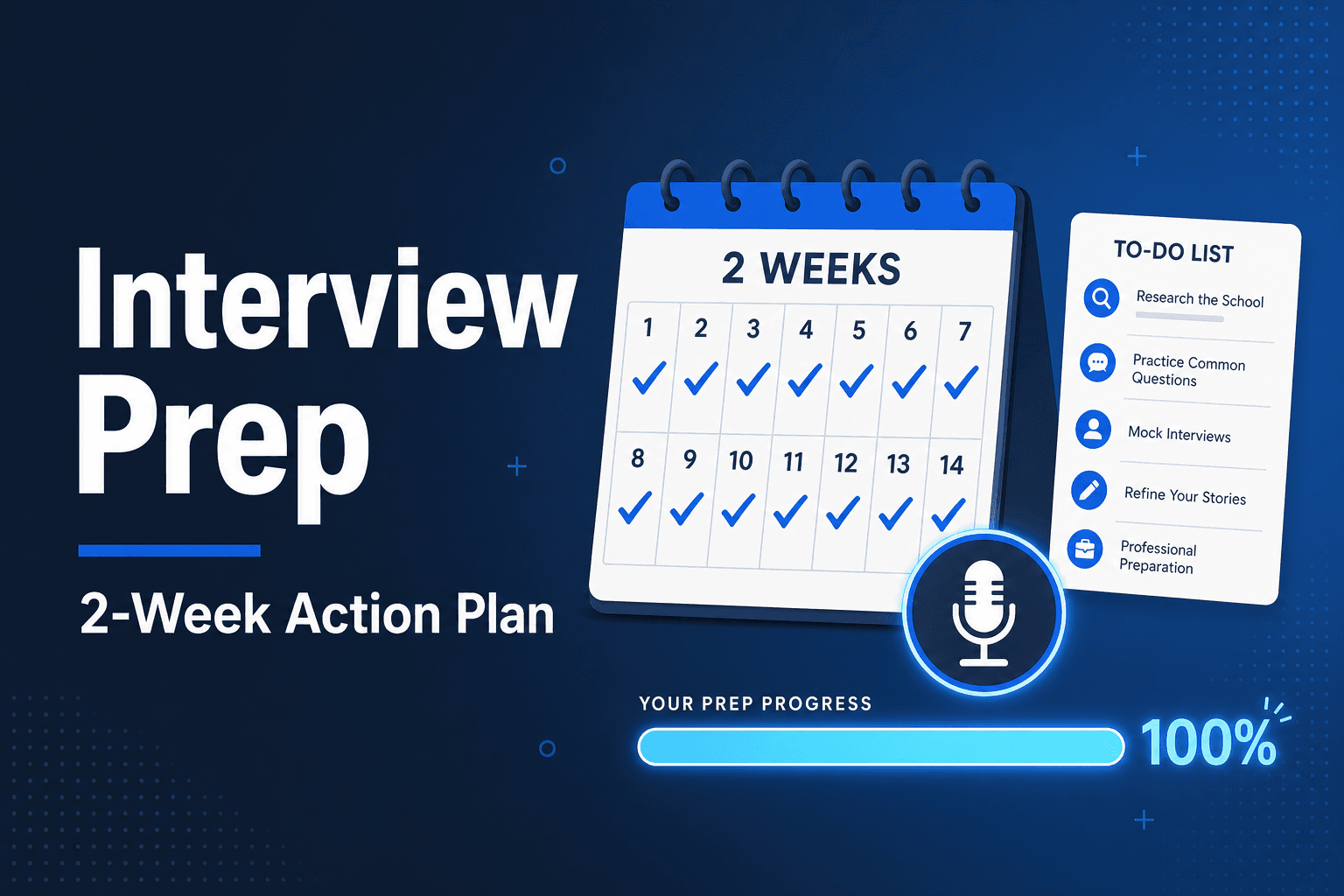
Two weeks is enough time to do this properly, if you use the time well. This guide gives you a specific, day-by-day plan to follow from the moment you receive your interview invitation to the morning of interview day.
First: Know Your Format
Before you start preparing content, confirm the format of your interview. Contact the admissions office or check your invitation email for details. The two most common formats are very different:
Traditional Panel Interview: One or two interviewers, 20–45 minutes, conversational. Questions are broader and responses can be longer. Your demeanor and rapport-building matter more.
MMI (Multiple Mini Interview): 6–10 short stations, 8–10 minutes each, different evaluator at every station. Questions are scenario-based. Brevity and clear reasoning matter more than charm. See our full MMI guide for station-by-station preparation.
Some schools use a hybrid: a traditional interview plus one or two MMI-style scenarios. Know what you're walking into.
The 2-Week Day-by-Day Plan
Days 1–2: Research and Orientation
Day 1 — Research the school deeply
This is the most skipped step, and it shows. Interviewers can tell within two minutes whether you did real research or skimmed the website the night before.
Go beyond the "About Us" page. Find:
- The school's stated mission and how it differs from peer programs
- Any specialty clinics, community outreach programs, or research centers they highlight
- Recent news — new building, new dean, new partnerships, curriculum changes
- Student-to-faculty ratio and clinical hours in the first and second year
- Where graduates tend to match for specialties or practice (rural vs. urban, private vs. public)
Write 3–4 specific things you found that genuinely interest you. These become your answers when they ask "Why our program specifically?"
Day 2 — Build your story inventory
You need 6–8 short, specific personal stories ready to deploy. Each story should be under 90 seconds and anchored in a real experience. Cover these categories:
- A moment that confirmed dentistry was right for you (your best clinical observation)
- A time you overcame a significant challenge
- A time you worked through conflict on a team
- A time you made a mistake and what changed afterward
- A patient or person you worked with who changed how you think
- Something you care about in oral health policy or access to care
- Why this specific school appeals to you
Write each story out in full. Not to memorize — just to get the details clear in your head.
Days 3–5: Content Preparation
Day 3 — The essential questions
Prepare responses for the core questions every program will ask in some form:
- "Tell me about yourself" (2-minute structured answer — not your life story, just your path to this application)
- "Why dentistry?" (specific, experience-based, see our full guide on answering why dentistry)
- "Why our program?"
- "What is your greatest strength?" (with a real example, not a trait claim)
- "What is your greatest weakness?" (something real that you've actively worked on)
- "Where do you see yourself in 10 years?"
Write your answers. Read them aloud. Cut anything that sounds like you're reciting.
Day 4 — Ethical and situational scenarios
Even traditional panel interviews increasingly include one or two scenario-based questions. Prepare for the most common categories:
- A patient refuses treatment that they need — what do you do?
- You witness a classmate or colleague behaving unethically — what do you do?
- You disagree with a supervisor's clinical decision — how do you handle it?
- A patient can't afford the recommended treatment — what options do you discuss?
For each one, practice the 4-step framework: identify who is affected, name the competing values, consider professional obligations, state your position with a reason.
Day 5 — Current issues in dentistry
Know the basics of 4–5 current oral health topics. Interviewers at research-focused programs often ask what you've been reading. Be able to discuss:
- The access-to-care gap (rural underserved communities, Medicaid coverage for dental)
- The oral-systemic connection (diabetes, cardiovascular disease, pregnancy outcomes)
- Workforce trends (dentist shortage in certain states, mid-level provider debates)
- Teledentistry and technology changes in practice
- Student debt and its effect on where new dentists choose to practice
You don't need expert-level depth. You need informed familiarity — enough to have a real conversation.
Days 6–9: Practice
Day 6 — Solo practice, recorded
Go through your "Tell me about yourself," your "Why dentistry," and two to three of your personal stories on camera. Watch it back with the sound off first — just observe your body language, eye contact, and whether you seem composed. Then watch with sound and listen for filler words ("um," "like," "you know"), incomplete sentences, and moments where you trail off.
Do not try to eliminate all imperfections. Real conversation has natural pauses. You are looking for patterns — habitual filler words, the tendency to look away at key moments, or the habit of explaining past the natural end of your answer.
Days 7–8 — Practice with a partner
Find someone who will ask you questions and give honest feedback. Ideally this is another applicant preparing for interviews, a pre-health advisor, or a mentor who will push back.
Ask them to do the following:
- Ask you a question, then immediately ask a follow-up you haven't prepared for
- Tell you the exact moment in each answer where they started to lose interest
- Flag every time you said something vague that you could have said specifically
For MMI applicants: Do a full timed circuit. Set a timer for 2 minutes reading, 8 minutes responding. Do 6 stations in sequence without breaking between them. This is physically and mentally different from doing one station at a time, and you need to experience the fatigue of it before interview day.
Day 9 — School-specific mock interview
Do one complete mock interview specifically tailored to the program you're interviewing at. If it's a panel school, have your partner play a formal interviewer. If it's an MMI school, do MMI-format stations.
After this session, write down the three answers you felt weakest on. Spend the evening revising those specifically.
Days 10–12: Refinement and Logistics
Day 10 — Refine your weakest answers
Go back to the three answers from Day 9. Rewrite them. Practice them specifically. Record one more time and compare to your Day 6 recording.
Day 11 — Logistics and preparation
- Confirm your travel arrangements, hotel, and exact interview location (not just the school — the specific building)
- Walk through (or map out) your morning routine so there are no variables on interview day
- Lay out your outfit. Business professional is standard. For a guide: dark suit or equivalent, conservative colors, minimal accessories, clean shoes. When in doubt, be more formal rather than less.
- Prepare what you're bringing: photo ID, any forms or documents the school asked for, printed directions as backup
- Prepare a list of 2–3 genuine questions to ask your interviewers. These should not be questions answered on the school's website. Good questions show you've done real research.
Day 12 — Light review and mental preparation
Do not cram new information today. Briefly review your story inventory and your school-specific notes. Confirm that your logistics are set.
Spend some time doing something that relaxes you. Physical activity helps. Sleep is the single highest-impact preparation you can do the night before an interview.
Day 13 (The Day Before): Rest and Reset
Your preparation is done. There is nothing new you can learn today that will help you tomorrow. Any new information will just add anxiety.
- Eat well
- Get to bed at a time that gives you 7–8 hours of sleep
- Do not read interview forums or Reddit threads — they will either make you nervous about questions you haven't prepared for, or give you false confidence about questions you have
- Review your story inventory one last time if it calms you, then put it away
Day 14 (Interview Day): Execute
Morning:
- Wake up with enough time to have a real breakfast and get ready without rushing
- Arrive at the location 15–20 minutes early — not 5, not 45
- If you have waiting time, do not review notes. Take slow, even breaths. Remind yourself that you have done the preparation.
During the interview:
- Listen to the full question before formulating your response. A brief pause before answering is not a weakness — it signals that you're thinking.
- Answer specifically. Every vague answer is an opportunity to be specific instead.
- When you don't know something, say so directly: "I don't have specific knowledge of that, but here's how I'd approach thinking about it..."
- For MMI: reset completely between each station. What happened in the last room is irrelevant.
One thing to remember: The interviewer wants you to do well. They have already decided you are worth interviewing. Your job is to show them that the version of you on paper is the same as — or better than — the version of you in person.
What to Do After the Interview
Within 24 hours: Send a brief, specific thank-you email to your interviewer(s) if you have contact information. Keep it to 3–4 sentences. Reference one specific thing from your conversation — this shows it was genuine, not a form letter.
Within the week: If you interviewed at multiple schools, make notes about each program while the details are fresh — your impressions, anything you learned, any questions that came up that you want to address in secondary materials.
While you wait: The average decision timeline after interviews ranges from 2 weeks to 4 months depending on the school and the cycle. Continue strengthening the rest of your application while you wait.
If You Want Structured Mock Interview Practice
Self-preparation gets you a significant portion of the way there. But the most efficient way to close the remaining gap is structured practice with honest feedback from someone who has evaluated interviews from the other side of the table.
At Future Dentist Prep, we run focused mock interview sessions — full panel format or MMI circuit — with specific, written feedback on every response. Most applicants notice a meaningful improvement in their clarity and composure after a single session.
Schedule a free consultation to find out if interview coaching makes sense for where you are in your preparation.
Written By

Dr. Alexander Takshyn
DMD, Admissions Consultant & Founder