
What Is the MMI and Why Do Dental Schools Use It?
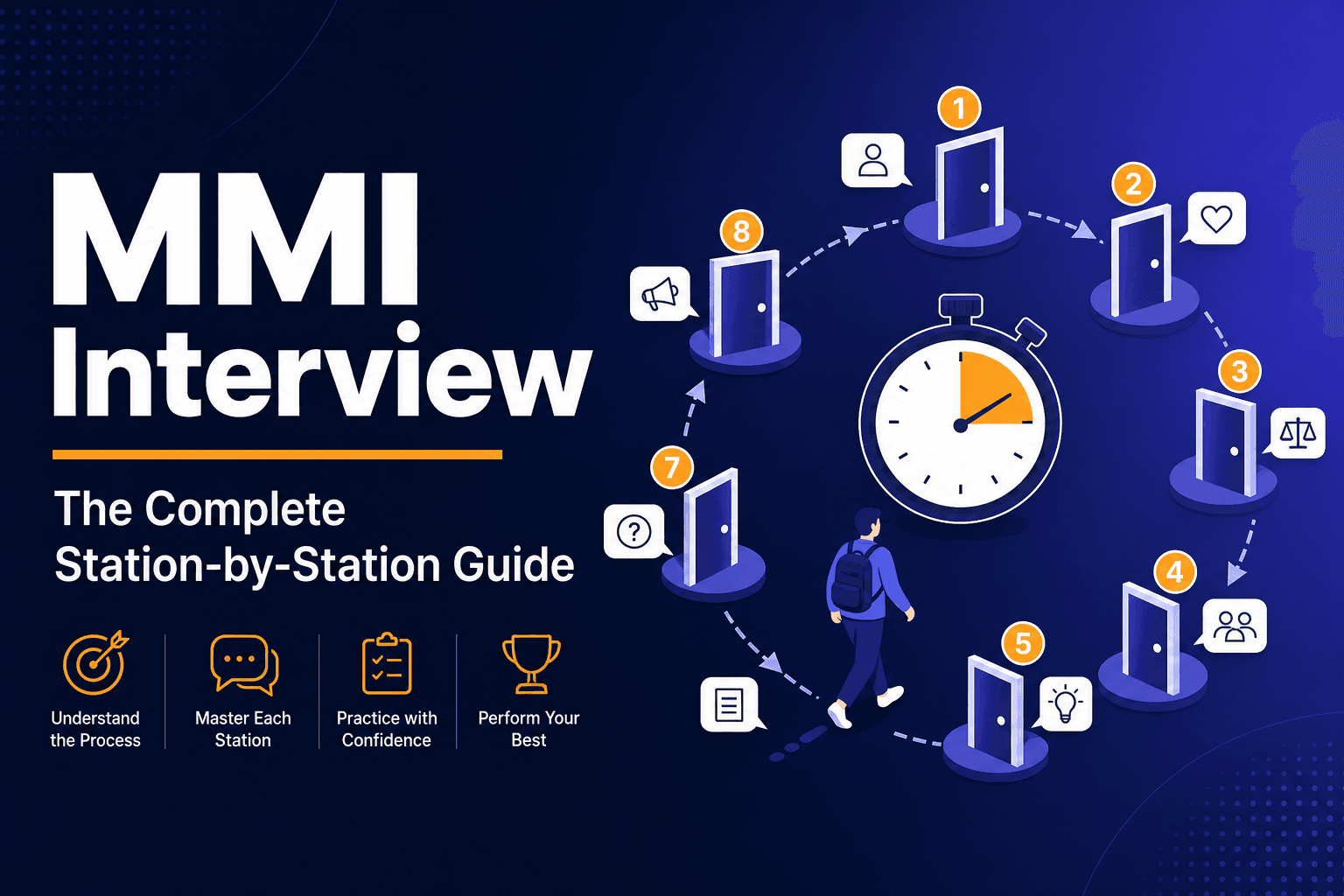
The Multiple Mini Interview (MMI) is an interview format used by a growing number of dental schools in the United States and Canada. Instead of a single long conversation with a panel, applicants rotate through a series of short, timed stations — typically 6 to 10 — each with a different evaluator and a different type of question or scenario.
The format was originally developed by medical schools to address a well-documented flaw in traditional panel interviews: interviewers who liked an applicant early in the conversation tended to rate everything they said more favorably, regardless of the quality of the response. The MMI reduces this bias by using multiple independent evaluators across multiple unconnected scenarios.
For dental schools specifically, the MMI is designed to assess competencies that GPA and DAT scores cannot: ethical reasoning, communication, empathy, professional judgment, and the ability to think under pressure.
Schools currently using the MMI format include:
- University of the Pacific Arthur A. Dugoni School of Dentistry
- Oregon Health & Science University School of Dentistry
- University of Nevada, Las Vegas School of Dental Medicine
- Boston University Henry M. Goldman School of Dental Medicine
- Many Canadian dental schools (University of Toronto, University of British Columbia, etc.)
Always check directly with programs you're applying to — formats change between cycles.
How the MMI Works: The Basics
Number of stations: Typically 6–10 stations per circuit
Time per station: Usually 8–10 minutes total per station. This often breaks down as:
- 2 minutes reading the prompt outside the door
- 6–8 minutes inside the room responding and answering follow-up questions
Who evaluates: Each station has a different trained evaluator — often faculty, current dental students, community members, or standardized patients
Scoring: Each evaluator scores independently using a rubric. Scores are combined at the end. Because each rater sees only one station, a poor performance at one station does not contaminate the rest of your evaluation.
What you wear: Same as a traditional interview — professional business attire
What you bring: Nothing. No notes are allowed inside stations. The prompt is on the door and sometimes repeated inside on a card.
The 6 Station Types You Will Encounter
Station Type 1: Ethical Dilemma
This is the station most applicants dread — and most often over-prepare for in the wrong direction.
What it looks like:
*"A dental student sees a classmate cheating on a practical exam. The classmate is a close friend. What should the student do?"*
What evaluators are looking for:
They are NOT looking for you to reach the "correct" answer. They are evaluating your reasoning process — whether you identify the competing interests, consider consequences for all parties, apply relevant professional principles, and arrive at a thoughtful position.
How to approach it:
Use a simple 4-step framework: 1. Identify who is affected and how 2. Name the competing values (loyalty vs. integrity, for example) 3. Consider what professional obligations are at stake 4. State your position and explain why
Model response (abbreviated):
*"There are a few competing interests here. My friend's career and reputation are at stake, but so is the integrity of the licensing process and ultimately the safety of future patients who will be treated by graduates of this program. The dental profession has a clear expectation of honesty in educational settings, and a student who cheats on a practical is practicing deception in exactly the kind of skill-based context that will matter in clinical care. I would talk to my friend privately first — not to ask them to confess, but to understand what happened and make clear I couldn't ignore it. If they weren't willing to address it themselves, I would report it to the faculty. This is difficult. But the integrity of the profession has to take precedence over a friendship."*
What to avoid:
- "It depends" without ever taking a position
- Refusing to acknowledge any conflict ("I would just report them immediately")
- Going off-topic into personal stories
Station Type 2: Communication / Empathy
What it looks like:
*"A patient has just been told they need to have a tooth extracted. They are visibly upset and insist they don't want the extraction. How do you respond?"*
Or a role-play version where you're actually speaking with an actor playing the patient.
What evaluators are looking for:
Active listening. Acknowledging the patient's feelings before jumping to clinical explanation. The ability to give information without being paternalistic or dismissive.
How to approach it:
- 1Pause and acknowledge the emotion first ("I can hear that this is upsetting")
- 2Validate that the concern is legitimate
- 3Provide information clearly and at an appropriate level
- 4Respect autonomy while ensuring informed consent
Model response (abbreviated):
*"The first thing I'd do is slow down. If a patient is visibly upset, launching straight into the clinical rationale for the extraction isn't going to help — they can't process it in that state. I'd acknowledge what they're feeling: 'I can see this isn't what you were hoping to hear, and that's a completely understandable reaction.' Then I'd give them space to ask questions before I explain anything. Once they're ready to hear more, I'd walk through what leaving the tooth might mean for adjacent teeth and overall oral health — in plain language, not clinical terminology. And I'd make clear the decision is theirs. My job is to make sure they have the information to make it. I wouldn't pressure them."*
Station Type 3: Reflection / Personal Experience
What it looks like:
*"Describe a time when you made a mistake and what you learned from it."*
*"Tell me about an experience that changed how you see a particular group of people."*
What evaluators are looking for:
Self-awareness. Genuine reflection. The ability to acknowledge failure without excessive self-criticism or deflection.
How to approach it:
Be specific. Name the mistake or experience clearly. Describe the impact honestly. Then explain what actually changed — not just "I learned to be more careful" but a concrete shift in behavior or perspective.
Common mistake: Choosing a mistake that is so minor it reads as humble-bragging ("I worked too hard on a project and missed a deadline"). Choose something real.
Station Type 4: Collaboration / Teamwork
What it looks like:
*"You are working on a group project and one team member is consistently not contributing. The deadline is in two days. What do you do?"*
What evaluators are looking for:
How you handle conflict within a team. Whether you prioritize the task, the relationship, or the principle — and whether your approach is proportionate and constructive.
How to approach it:
- 1Clarify what you know (don't assume the person is lazy — there may be circumstances you're unaware of)
- 2Direct, private conversation with the person first
- 3Escalate only if necessary
- 4Keep the team's goal in focus throughout
Station Type 5: Healthcare / Current Issues
What it looks like:
*"What is your opinion on water fluoridation? What are the arguments for and against it?"*
*"How does the shortage of dentists in rural communities affect public health?"*
What evaluators are looking for:
That you can discuss a nuanced issue with balance and accuracy. That you have genuine familiarity with oral health policy. That you can hold a position without being dismissive of counterarguments.
How to approach it:
Prepare 3–4 current dental/public health topics before your interview. Know the evidence. Know the main counterarguments. Be able to summarize both sides before offering your own view.
Topics to know:
- Access to care in underserved communities
- Water fluoridation (evidence, controversy, CDC position)
- The oral-systemic health connection (diabetes, cardiovascular disease)
- Teledentistry and its role in expanding access
- Student loan burden and dentist distribution
Station Type 6: "Why Dentistry" / Motivation
What it looks like:
*"Walk me through what led you to apply to dental school."*
*"What experience made you most certain that dentistry was the right career for you?"*
What evaluators are looking for:
Authentic motivation backed by real experience. See our full guide on How to Answer "Why Dentistry?" for a detailed breakdown of this question.
MMI Scoring: How You Are Actually Evaluated
Each station evaluator uses a rubric that typically scores several dimensions:
| Dimension | What It Assesses |
|---|---|
| Communication | Clarity, active listening, appropriate tone |
| Reasoning | Logic, consideration of multiple perspectives |
| Professionalism | Composure, appropriate language, ethical grounding |
| Empathy | Recognition of others' feelings and interests |
| Knowledge | Relevant factual accuracy (where applicable) |
Scores across all stations are aggregated. Most programs weight MMI scores heavily — often equally to or more than academic metrics in the interview stage.
Important: A single bad station does not end your candidacy. Because each evaluator is independent, a poor performance at station 3 has no effect on how station 5 is scored. This is very different from a traditional panel interview where one bad answer can color the committee's perception of everything that follows.
How to Prepare: A 4-Week MMI Plan
Week 1: Understand the Format and Build Your Framework
- Read this guide thoroughly
- Research which specific stations the schools you've been invited to use (ask current students, check forums)
- Learn the basic ethical frameworks: autonomy, beneficence, non-maleficence, justice
- Practice the 4-step ethical reasoning process until it's automatic
Week 2: Content Knowledge
- Study 5–6 current dental/public health topics
- Read recent ADA policy statements on access to care, fluoridation, and dental workforce issues
- Learn the oral-systemic connection research basics
- Prepare 3–4 personal stories you can adapt for reflection and teamwork stations
Week 3: Timed Practice
- Find a practice partner (ideally another applicant or a current dental student)
- Practice with actual MMI prompts — many are available on Reddit's r/PreDental, SDN forums, and various prep books
- Time yourself strictly: 2 minutes reading, 8 minutes responding
- Record yourself on video at least twice — watch for filler words, eye contact, and pacing
Week 4: Refinement and Logistics
- Do at least one full mock circuit (6–8 stations in sequence) with a partner
- Finalize your travel and lodging arrangements for interview day
- Prepare your interview outfit and have it ready
- Plan your morning routine to arrive calm and with time to spare
On the Day: What to Expect
Arrival: You'll typically check in with an administrator who explains the format and timing. Most programs have a group orientation before the circuit begins.
The waiting room: Between stations you'll be in a waiting area or hallway. Do not discuss prompts with other applicants who have already gone through — this is typically prohibited and can disqualify you.
Reading time: Use every second. Identify the core issue. Sketch a 3-point structure in your head. Decide on your position before you walk in.
Inside the station: Greet the evaluator naturally. They will often say very little — this is intentional. They want to hear you talk, not have a conversation. Don't interpret silence as disapproval.
Follow-up questions: Be ready for pushback. "What if the situation were different?" or "What if your friend asked you not to report them?" These are designed to see how you handle pressure on your position. It's fine to adjust your reasoning — just explain why.
Between stations: Take a breath. Reset completely. What just happened at the last station is irrelevant.
The Single Most Common MMI Mistake
The biggest error applicants make is trying to give the "right" answer rather than showing their thinking process.
MMI evaluators are not looking for a specific conclusion. They are watching how you think. An answer that identifies the right ethical tension, considers multiple stakeholders, acknowledges complexity, and arrives at a thoughtful position — even an imperfect one — will outscore a confident recitation of a memorized "correct" answer every time.
Think out loud. Show your reasoning. And when you're not sure, say so — and then work through it anyway.
If you'd like to do a mock MMI session with personalized feedback from someone who has reviewed dental school applications from the inside, reach out to Future Dentist Prep. We work through actual MMI circuits with applicants and give you the specific, actionable feedback you need to perform at your best.
Written By

Dr. Alexander Takshyn
DMD, Admissions Consultant & Founder