
Why PAT Destroys More DAT Scores Than Any Other Section
Ask any pre-dental student which DAT section surprised them most — and nine times out of ten, the answer is PAT.
Not Organic Chemistry. Not Biology. The Perceptual Ability Test.
Here's why: every other DAT section tests knowledge. You learn it, you practice applying it, you get better. PAT is different. It tests visual–spatial skill under time — mental rotation, 3D from 2D, and pattern recognition — not memorized content. Most students have never trained that skill deliberately.
The good news: PAT ability is trainable. Students who commit to daily practice over 8–12 weeks routinely improve by 3–5 points on this section alone. That kind of improvement on a single section can move your Academic Average by a full point or more.
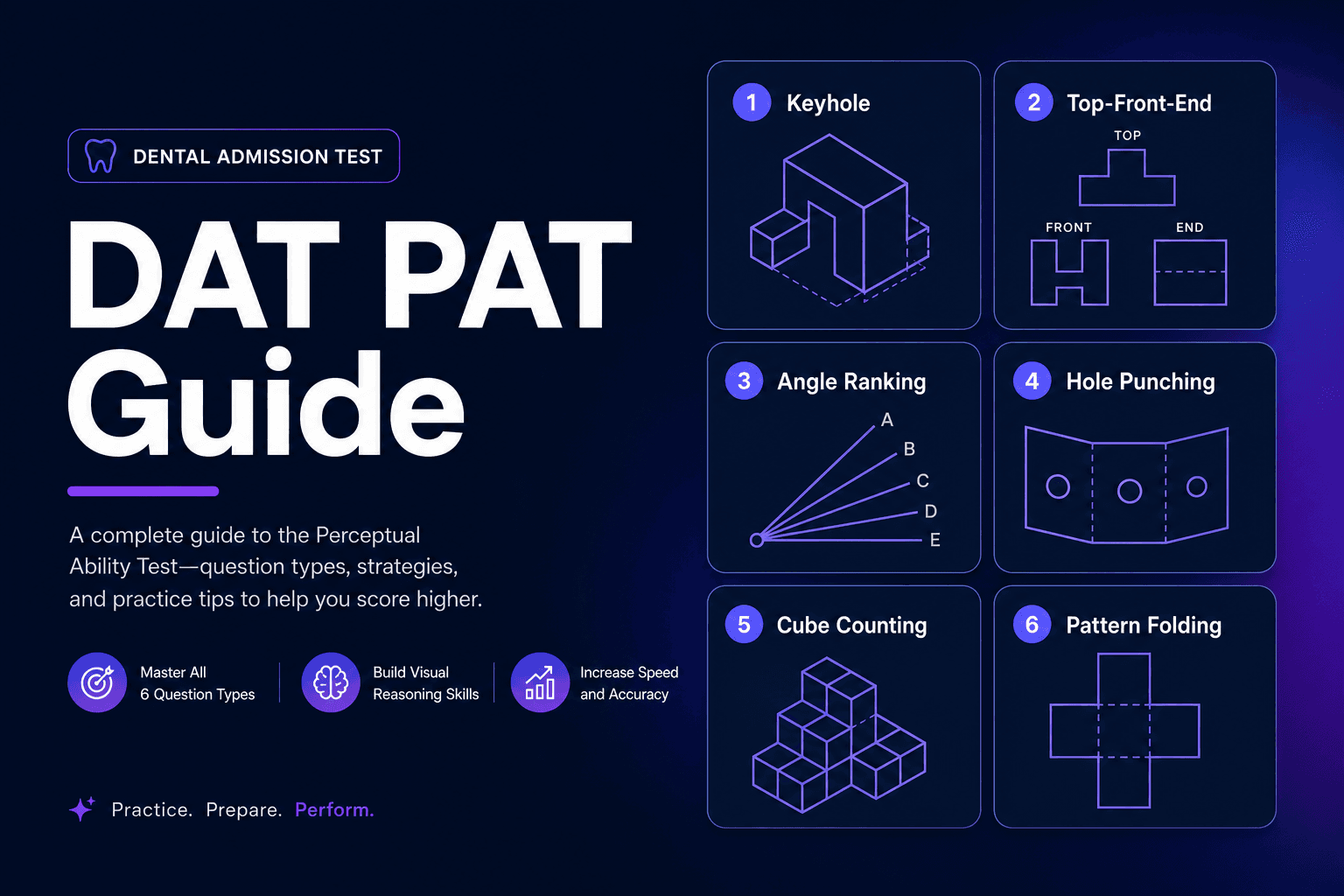
This guide covers all six PAT question types, the most effective strategy for each, common mistakes that cost students points, and how to build a practice routine that raises your score. For targeted drills by question family, use our DAT spatial reasoning practice guide.
PAT Format and Scoring: What You're Actually Dealing With
The Perceptual Ability Test is the second section of the DAT, immediately following the Survey of Natural Sciences. Here's the structure:
| Detail | Value |
|---|---|
| Number of questions | 90 total |
| Time allowed | 60 minutes |
| Time per question | ~40 seconds |
| Question types | 6 types, 15 questions each |
| Score range | 1–30 |
| Competitive score | 18+ |
| Strong score | 20+ |
| Top programs | 21–23+ |
Forty seconds per question. Sixty minutes. Ninety questions. Six completely different types of visual reasoning — back to back, with no breaks between types.
This is not a section you can bull your way through on test day. Speed and accuracy both matter, and both are built through practice — not through reading explanations.
The 6 PAT Question Types
1. Keyhole (Apertures)
What it tests: Given a 3D object, identify which hole (aperture) it can pass through without rotating or forcing.
How it works: You're shown a 3D shape on the left and five 2D silhouette outlines on the right. The object must be able to pass through the hole straight-on — no rotation, no tilting, no forcing. You're choosing which silhouette is an accurate representation of the object's profile from a specific viewing angle.
The core strategy — systematic elimination:
Work by eliminating wrong answers rather than searching for the right one. 1. Look at the object from the front. Eliminate any aperture that doesn't match the front profile. 2. Look at the object from the top. Eliminate any aperture inconsistent with the top profile. 3. Look at the object from the side. The remaining aperture is your answer.
Most students try to find the right answer immediately — this leads to errors when two options look similar. Elimination is faster and more accurate.
Common mistake: Forgetting that the object must pass completely through the aperture — not just fit into it. If any part of the object is wider than the hole, that aperture is wrong.
Practice focus: Start with simple shapes (cubes, cylinders, L-shapes) and add complexity as you improve. The first 5–10 keyhole questions in any practice set are usually simpler — use them to build speed before the harder ones appear.
2. Top-Front-End (Orthographic Projections)
What it tests: Given two of the three orthographic projections (top, front, end/side views) of a 3D object, identify the missing third view.
How it works: Orthographic projection is a standardized engineering drawing technique where a 3D object is represented by flat 2D views from three perpendicular angles. The test gives you two views and asks you to determine what the third would look like.
The core strategy — build the object mentally:
- 1From the front view, establish the object's height and width.
- 2From the top view, establish the object's depth and width.
- 3Combine these to mentally construct the 3D object.
- 4Now ask: what does this object look like from the end/side?
The line rule: In orthographic projections, solid lines represent visible edges and dashed lines represent hidden edges. When evaluating answer choices, eliminate any that have solid lines where there should be dashed lines (or vice versa).
Common mistake: Students try to work directly from 2D views without building the 3D object first. This leads to confusion when the views are for a complex object. Always build the 3D object in your mind before evaluating the third view.
Practice focus: Draw physical 3D objects from household items (boxes, cups, books) and practice creating their three orthographic views. Then reverse the process. This physical practice builds the mental translation skill faster than purely screen-based practice.
3. Angle Ranking
What it tests: Given four angles labeled A, B, C, and D, rank them from smallest to largest (or largest to smallest, as specified).
How it works: Four angles are displayed, and you choose which answer correctly orders them from smallest to largest. This sounds simple — and it mostly is — but the test deliberately presents angles that appear similar in size to create confusion.
The core strategy — use the baseline method:
Mentally extend one arm of each angle to a common baseline. When all four angles share the same reference point and one arm direction, their differences become much more visually apparent. Angles that appear ambiguous in isolation become clearly distinguishable when normalized.
Speed tip: Angle ranking is the fastest PAT question type for most students once they have a strategy. Target completing all 15 angle ranking questions in under 8 minutes, leaving more time for keyhole and top-front-end.
Common mistake: Misjudging obtuse angles. An angle that appears large because its arms are long may actually be smaller than a compact angle with short arms. What matters is the degree of opening between the arms — not the length of the arms.
Practice focus: Practice on paper first, drawing angles and ranking them. Then move to timed digital practice. Build the habit of using the baseline method on every question — don't skip it even when an angle seems obviously smallest or largest.
4. Hole Punching (Paper Folding)
What it tests: A square piece of paper is shown being folded one or more times, then punched through with a hole. When unfolded, what does the pattern of holes look like?
How it works: Each question shows 2–4 fold steps (usually depicted as the paper folding along a dotted line) followed by a hole punch. You must determine where the holes appear when the paper is fully unfolded. Answer choices show 5 possible hole patterns.
The core strategy — reverse unfold:
Work backward from the hole punch, unfolding one step at a time. 1. Start with the punched hole in its current position. 2. For each fold in reverse order, reflect the hole across the fold line to show where the reflected hole appears. 3. Repeat for each fold until fully unfolded. 4. The total set of holes is your answer.
The symmetry principle: Every fold creates a reflection. A single fold creates 2 holes (original + reflection). Two folds create 4 holes. Three folds create 8 holes. If your answer has the wrong number of holes, you've made an error.
Common mistake: Misidentifying the fold line direction. Pay careful attention to whether the fold is horizontal, vertical, or diagonal — the reflection axis is different for each, and a wrong axis completely changes the answer.
Practice focus: Use actual paper. Fold a real piece of paper, punch a hole with a pen, unfold it, and verify your mental prediction against the actual result. This physical practice builds intuition for reflections far faster than purely visual practice.
5. Cube Counting
What it tests: Given a 3D structure of cubes stacked on a surface, count how many individual cubes have exactly 1, 2, 3, 4, or 5 of their faces painted — given that the structure is dipped in paint on all exposed outer surfaces, and cubes resting on the ground do not have their bottom face painted.
How it works: The question shows a stacked cube structure and asks something like: "How many cubes have exactly 3 painted faces?" You must visualize which cubes are in corner positions (3 exposed faces), edge positions (2 exposed faces), face positions (1 exposed face), or interior positions (0 exposed faces).
The core strategy — position mapping:
Rather than counting painted faces on individual cubes, categorize cubes by position:
- Corner cubes (exposed on 3 sides): always have 3 painted faces
- Edge cubes (exposed on 2 sides): always have 2 painted faces
- Face cubes (exposed on 1 side): always have 1 painted face
- Interior cubes (surrounded): always have 0 painted faces
The tricky part: structures are not always simple rectangles. They have overhangs, recesses, and irregular shapes. For each cube, ask: how many of its 6 faces are exposed to the outside environment? Don't forget the bottom face rule — cubes resting on the ground (or on another cube) don't count that face as painted.
Common mistake: Forgetting that cubes resting on other cubes block the top face of the cube below. The bottom face of a cube sitting on top of another cube is also not painted (it's touching another cube, not exposed).
Practice focus: Build physical cube structures with sugar cubes, dice, or building blocks. Count painted faces on the physical structure. This 3D tactile practice builds spatial intuition much faster than screen practice alone.
6. Pattern Folding (3D Form Development)
What it tests: Given an unfolded 2D pattern (a net), determine which 3D shape it folds into.
How it works: You're shown a flat, cross-like or irregular 2D shape — a net — which represents the unfolded surface of a 3D geometric solid. You must choose which of 4 answer choices correctly represents the 3D shape that net would fold into.
The core strategy — anchor and fold:
- 1Identify the base face — usually the largest or most central panel in the net.
- 2Mentally fold each adjacent face up from the base.
- 3Focus on the faces that will be visible from the front of the 3D shape.
- 4Pay special attention to edge relationships — faces sharing an edge become adjacent faces on the 3D solid.
The pattern check: When answer choices have patterns, markings, or shading on faces, use these as eliminators. A marking on a specific face of the net must appear on the correct face of the 3D solid with the correct orientation. Wrong orientation = wrong answer.
Common mistake: Ignoring face orientation. Students often correctly identify which faces are visible but choose an answer where the pattern on a face is rotated incorrectly. Always check orientation, not just which faces are showing.
Practice focus: Crack DAT PAT has the most varied pattern folding practice bank. Focus on nets with markings or asymmetric patterns — these eliminate wrong answers fastest. Practice identifying the base face immediately and building from there.
Time Management Strategy for PAT
With 90 questions in 60 minutes, time management is as important as accuracy.
Target time allocation by question type:
| Question Type | Questions | Target Time | Seconds/Question |
|---|---|---|---|
| Keyhole | 15 | 12 min | ~48 sec |
| Top-Front-End | 15 | 15 min | ~60 sec |
| Angle Ranking | 15 | 7 min | ~28 sec |
| Hole Punching | 15 | 10 min | ~40 sec |
| Cube Counting | 15 | 8 min | ~32 sec |
| Pattern Folding | 15 | 8 min | ~32 sec |
| Total | 90 | 60 min | ~40 sec avg |
Top-Front-End is your time bank — it's the most complex question type. If you're fast on Angle Ranking and Cube Counting (which most students are with practice), you create buffer time for Top-Front-End.
The triage rule: On timed practice, never spend more than 90 seconds on any single question. If you're stuck, mark your best guess and move on. A question you spend 2 minutes on is worth the same 1 point as a question you solve in 20 seconds. Don't let one difficult question steal time from 3 easy ones.
The Daily PAT Practice Plan That Actually Works
Phase 1: Learn Each Type (Weeks 1–2)
Work through each of the 6 question types individually — not mixed. Spend 2 days on each type:
- Day 1: Read the strategy, watch video walkthroughs, solve 15 questions untimed
- Day 2: Solve 15 questions with a relaxed time limit (2x normal pace), analyze every error
By the end of week 2, you should have a working strategy for each type and a clear sense of which types are your weakest.
Phase 2: Mixed Practice with Timing (Weeks 3–7)
This is where real improvement happens. Every day:
- Complete a full PAT section (90 questions) in 60 minutes
- After scoring, analyze every wrong answer: was it a knowledge gap, a strategy error, or a timing mistake?
- Spend 20 minutes on your weakest type with focused drill
The key: always timed. Untimed practice builds false confidence. Timed practice builds the actual skill the test demands.
Phase 3: Full-Length Integration (Weeks 8–10)
- Take full-length DAT practice tests 2–3 times per week (PAT included)
- Track your PAT score by question type across all practice tests
- Identify the 1–2 question types where you're still losing the most points and focus your remaining prep there
The Non-Negotiable Rule: Practice Every Day
PAT skills degrade faster than knowledge-based skills when you take days off. Even on light study days, do at least 15 PAT questions. The visual skills you're building need consistent activation to stick.
Best Resources for DAT PAT Practice
| Resource | Best For | Cost |
|---|---|---|
| Crack DAT PAT | Largest PAT-specific practice bank, all 6 types | Paid |
| DAT Bootcamp PAT | Realistic difficulty calibration, detailed explanations | Paid |
| DAT Destroyer | High-difficulty practice (harder than real exam) | Paid |
| ADA Official Practice Tests | Most accurate difficulty for real exam calibration | Paid |
| YouTube (search each type) | Free walkthroughs, especially Top-Front-End | Free |
Crack DAT PAT is the gold standard for PAT-specific practice volume. If you're serious about improving PAT, it's worth the investment. DAT Bootcamp has excellent explanations for each question — valuable for understanding why you got something wrong, not just what the right answer was.
The PAT Score You Should Actually Target
What PAT score do you need? Here's the realistic benchmark:
| PAT Score | Assessment |
|---|---|
| Below 17 | Significantly below average — needs major improvement |
| 17–18 | Below competitive range — targeted practice required |
| 19–20 | Competitive at most programs |
| 21–22 | Strong — above average for most programs |
| 23+ | Exceptional — top percentile |
The national average PAT score for dental school applicants is approximately 18–19. Most competitive programs want to see 19+. Top programs (Penn, Harvard, Columbia) typically see entering classes averaging 21+.
If your practice PAT scores are consistently below 18, this section deserves more daily time — not less. Every point you add to PAT adds directly to your Academic Average. A 3-point PAT improvement (17 → 20) can increase your AA by almost a full point when averaged across all sections.
Frequently Asked Questions
How long does it take to improve your DAT PAT score?
Most students see measurable improvement within 3–4 weeks of consistent daily practice (30–60 minutes/day). Significant improvement — 3–5 points — typically requires 8–10 weeks of structured daily practice. Students who practice PAT sporadically or less than daily see much slower progress.
Is PAT harder on the real DAT than on practice tests?
DAT Bootcamp is calibrated to be approximately the same difficulty as the real exam on PAT. Crack DAT PAT can be slightly easier for some question types. ADA official practice tests are the closest proxy for real exam difficulty. If your Bootcamp PAT scores are consistently 20+, expect a similar result on test day.
What if I'm naturally bad at PAT / visual puzzles?
Natural aptitude varies — but PAT scores improve significantly with targeted practice. Students who describe themselves as "terrible at spatial stuff" and then commit to 8 weeks of daily PAT practice routinely achieve scores they thought were impossible. The key is consistency and correct technique, not innate talent. Use our DAT spatial reasoning practice guide for drills by question type.
Should I skip PAT questions I find difficult and come back to them?
Yes — with a caveat. Flag difficult questions and make your best guess before moving on. The DAT does not penalize wrong answers, so leaving any question blank is worse than guessing. If time allows, return to flagged questions. If not, your best guess is already recorded.
Can I use scratch paper during the PAT section?
Yes. You are provided a physical whiteboard and marker at the testing center. Use it — especially for hole punching (tracking fold steps), angle ranking (baseline method), and cube counting (tallying cubes by type). Students who use scratch paper score higher than students who try to work purely mentally.
Is PAT weighted more heavily in the DAT score calculation?
No. The PAT score is one of the four subsection scores used to calculate the Academic Average (AA) — it carries the same weight as the Reading Comprehension, Quantitative Reasoning, and Total Science scores. However, because it's the section where the highest variance in applicant performance exists, a strong PAT score differentiates you more meaningfully than a strong QR score where most students perform similarly.
Your PAT Improvement Plan Starts Today
The students who score 21+ on PAT are not smarter than the students who score 17. They practiced differently — more consistently, more deliberately, and with specific strategies for each question type.
Start with the type you find hardest. Build the strategy, practice it untimed, then timed, then under full exam conditions. Move to the next type. Repeat for all six. Then integrate them into full timed PAT sections daily.
If you want a personalized DAT study plan that integrates PAT practice into your full prep schedule — or if you're stuck on a specific question type and need expert guidance — a DAT tutor can diagnose your specific errors and accelerate your improvement far faster than self-study alone.
For drilled practice by question type (keyhole, angle ranking, cube counting, hole punching), use our dedicated DAT spatial reasoning practice guide.
For a complete overview of the entire DAT and how to approach every section, read our full DAT study guide. And if you're ready to talk through your full application strategy, schedule a free call with our team.
Written By

Dr. Alexander Takshyn
DMD, Admissions Consultant & Founder