

Why Most Personal Statements Stall Before They Start
The AADSAS dental school personal statement is 4,500 characters — including spaces. That is short. Most applicants waste the first 1,000 characters warming up, then rush the ending. Admissions committees notice.
This guide walks you through the full process: what to write, how to structure it, how to revise it, and how to finish under the character limit without sounding generic. If you already have a draft, pair this with our guides on personal statement examples and common mistakes that get you rejected.
Step 1: Know the Assignment (Before You Write a Word)
Platform: AADSAS (American Association of Dental Schools Application Service)
Limit: 4,500 characters (not words)
Audience: Admissions committee members who will also see your GPA, DAT, activities, and letters
Job of the statement: Explain who you are and why dentistry — with specificity that your Activities section cannot provide
Your personal statement is not a second resume. It is not a list of shadowing hours. It is the one place you control the narrative.
Step 2: Brainstorm With Evidence, Not Vibes
Before drafting, write short answers to these prompts. Force specifics — names, places, numbers, moments:
- 1What is the single clinical moment that made dentistry feel real to you?
- 2What did you believe about dentistry before shadowing — and what changed?
- 3What problem in oral health do you actually care about (access, fear, pain, prevention, specialty care)?
- 4What strength do you bring that is not already obvious from your transcript?
- 5What would a mentor say is uniquely "you" in a clinical setting?
If your answers are still "I love helping people" and "science and art," you are not ready to draft. Go get another shadowing shift or re-read your reflection notes first.
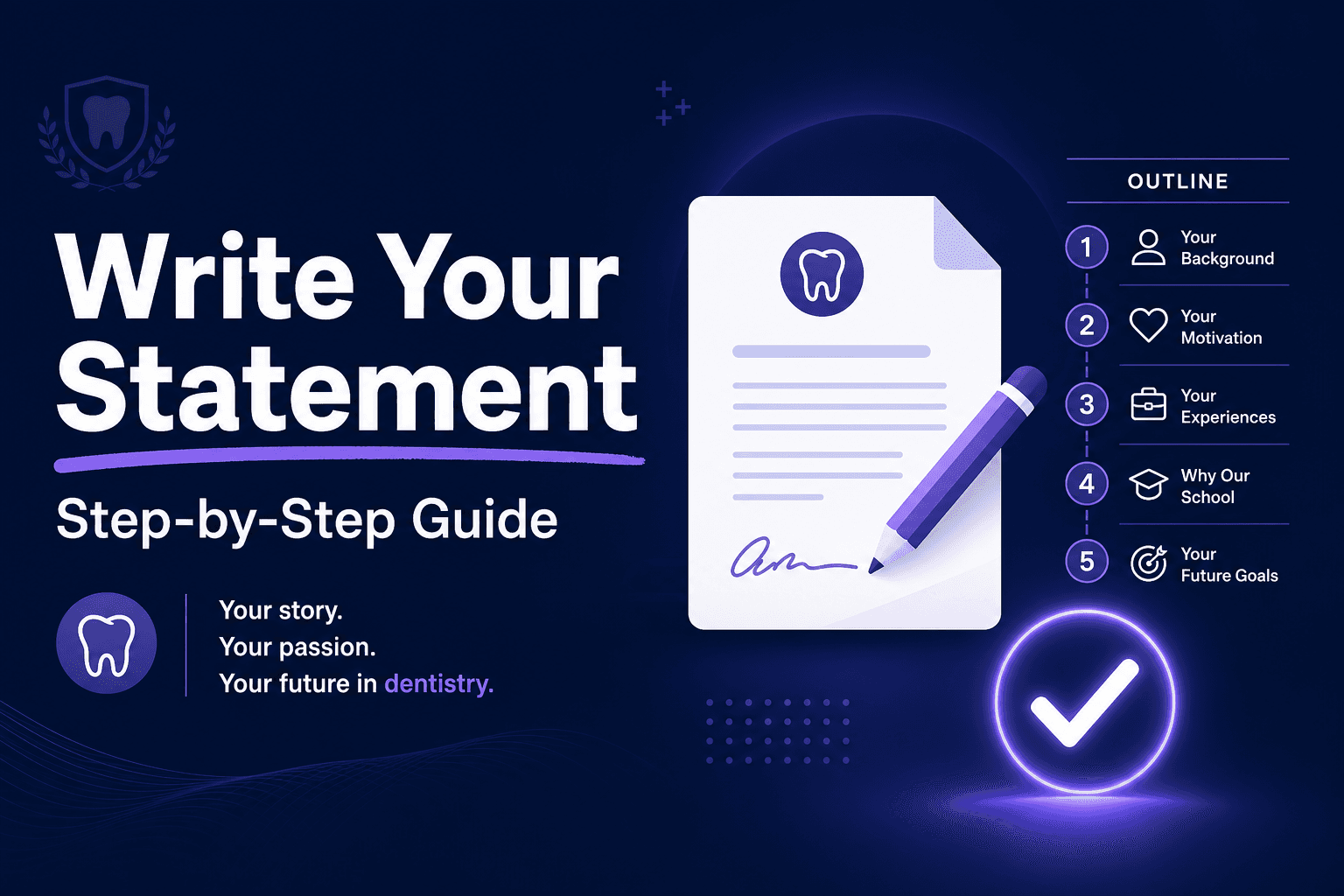
Step 3: Use a Structure That Fits 4,500 Characters
A reliable AADSAS structure:
| Section | Approx. characters | Purpose |
|---|---|---|
| Hook | 350–500 | One vivid moment or observation |
| Why dentistry | 800–1,000 | Experience-based motivation |
| What you bring | 800–1,000 | Distinctive background / values in action |
| Growth / preparation | 700–900 | How you prepared (not a resume dump) |
| Close | 400–550 | Forward-looking, memorable ending |
Total target: 3,800–4,300 characters on your strong draft, so you have room to polish.
Step 4: Write the Hook Last (Or Rewrite It Last)
Most strong statements start with a scene:
- A patient interaction
- A precise clinical observation
- A turning-point conversation with a dentist
Avoid openings that begin with:
- "I have always wanted to be a dentist"
- "Ever since I was a child"
- "Dentistry is the perfect blend of art and science"
Those lines are invisible. Your hook should make a tired reader look up.
Step 5: Make "Why Dentistry" Specific to Dentistry
Every sentence in this section should fail the substitution test. If you can replace "dentistry" with "medicine" or "nursing" and the sentence still works, rewrite it.
Strong "why dentistry" writing includes:
- What you observed in dental settings specifically
- What surprised you about the work
- What kept you coming back after multiple experiences
Weak writing asserts passion. Strong writing shows pattern recognition over time.
Step 6: Show Growth Without Excuses
If you need to address a GPA dip, a gap year, or a late decision to pursue dentistry, do it briefly and constructively:
- One or two sentences of context
- What changed in your behavior or results
- Immediate return to forward-looking substance
Do not turn the personal statement into a defense brief. Use the AADSAS additional information section when a longer academic explanation is needed.
Step 7: Revise Like an Admissions Reader
Do at least three revision passes:
Pass 1 — Specificity: Highlight every vague phrase ("passionate," "unique," "rewarding"). Replace with evidence.
Pass 2 — Structure: Does each paragraph earn its place? Cut anything that repeats your Activities list.
Pass 3 — Sound: Read the whole statement aloud. Where you stumble, the reader will too.
Then get feedback from someone who does not already know your story. Family members fill in missing context. That is exactly what committees cannot do.
Step 8: Character-Count Like It Matters (Because It Does)
Practical tips for the 4,500-character limit:
- Draft in a plain text tool that shows character count with spaces
- Cut throat-clearing phrases ("I believe that," "It is important to note that")
- Prefer concrete nouns and verbs over adjectives
- Never submit at 4,499 with a weak closing — protect the ending
Pre-Submit Checklist
- Opening is a specific moment, not a cliché
- "Why dentistry" fails the medicine-substitution test
- At least three concrete details (names, places, numbers, or scenes)
- No resume dump of activities already listed elsewhere
- Closing leaves a memorable image or intention
- Under 4,500 characters including spaces
- Read aloud by you and by one outside reader
How This Fits Your Full Application
Your personal statement works best when it aligns with:
- Your application timeline
- Your interview answers, especially why dentistry
- Your secondary essays (next guide below in this cluster)
If you want line-by-line feedback from someone who has reviewed dental applications from the admissions side, schedule a free consultation with Future Dentist Prep.