
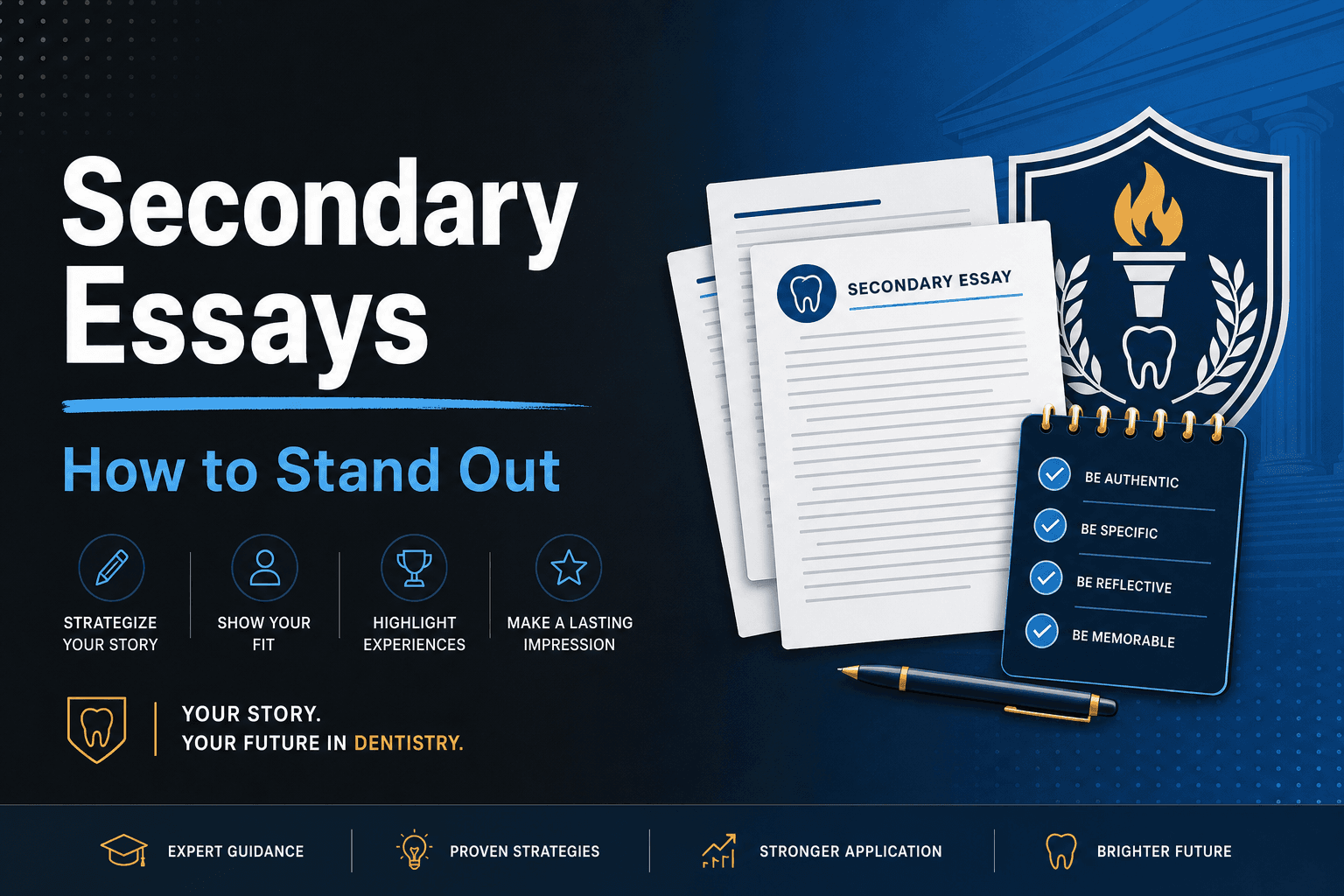

Why Secondary Essays Matter More Than Applicants Think
Your AADSAS primary gets you into the pile. Secondary essays often decide whether you get an interview invite.
Schools use secondaries to test three things:
- 1Did you research this program specifically?
- 2Can you communicate clearly under short prompts?
- 3Are your values and experiences a real fit — or copy-paste?
Applicants who treat secondaries like "extra busywork" send generic answers to every school. Committees can tell within a paragraph.
This guide covers the most common dental school secondary prompts, a reusable writing system, and how to tailor fast without sounding fake.
When Secondaries Arrive (And Why Speed Matters)
Many schools send secondaries soon after your primary is verified. Some send them to almost every applicant; others are more selective. Either way, delayed secondaries signal low interest.
Practical rule: Aim to return each secondary within 7–14 days of receiving it — sooner if the school is a top choice and you already have strong material ready.
Build a secondary toolkit before peak season so you are not inventing every answer from scratch in August.
The Most Common Dental School Secondary Prompts
1. "Why our school?"
The highest-stakes prompt. Generic praise ("excellent clinical training," "diverse patient population") fails.
What works:
- 2–3 school-specific details (clinic model, community partnerships, curriculum structure, research centers, mission language)
- A clear link between those details and your experiences
- No brochure paraphrasing
Quick test: If your answer could be sent to three other schools unchanged, rewrite it.
2. Diversity / adversity / challenge
Schools want insight and maturity — not trauma dumping or inspiration-poster language.
What works:
- One focused experience
- What you learned in behavioral terms
- How it shapes how you will show up for patients or classmates
3. Leadership / teamwork
Avoid title-flexing ("I was president of..."). Show conflict, coordination, and outcome.
4. COVID / gap / academic explanation
Be direct, brief, and responsible. Explain impact, then show recovery or adaptation. Do not over-explain.
5. Future goals / practice setting
Be honest and grounded. "I want to help people smile" is not a goals statement. Rural access, public health dentistry, specialty interest exploration, academic dentistry — pick a direction that matches your evidence.
6. Is there anything else we should know?
Use only if it adds new, useful information. Do not rehash your personal statement.
A Fast System for Writing Strong Secondaries
Step A: Build a master story bank (once)
Create 8–10 short story blocks (80–150 words each):
- Clinical moment
- Underserved / access experience
- Team conflict
- Leadership example
- Academic challenge recovery
- Why dentistry confirmation moment
- Research or project impact
- Community service with a concrete result
You will remix these across schools. You will not paste them unchanged.
Step B: Build a school research sheet (per program)
For each school, capture:
- Mission keywords
- Unique clinics or community programs
- Curriculum features (PBL, early clinical exposure, etc.)
- Location-specific patient population notes
- Any faculty / initiative that genuinely interests you
Step C: Write with a 3-part mini structure
For most prompts: 1. Direct answer in the first sentence 2. One concrete example 3. School-specific link or forward-looking close
This keeps you under word limits and readable.
How to Tailor Without Sounding Fake
Bad tailoring:
"I am drawn to your renowned faculty and state-of-the-art facilities."
Better tailoring:
"Your community clinic rotations serving [specific population] match the patient advocacy work I started at [your site], where I learned how transportation and cost shape whether people complete treatment plans."
Notice the difference: the second answer uses the school's real feature as a bridge to your lived experience.
Word Limits: Write Tight
Secondary limits vary (250–750 words is common; some are shorter). Rules of thumb:
- First sentence answers the question
- One example beats three vague claims
- Cut throat-clearing intros
- End on fit or future contribution, not flattery
If you are also polishing your primary statement, use our how to write a dental school personal statement guide so primary and secondaries do not repeat the same paragraph.
Common Secondary Essay Mistakes
- 1Same "Why us?" essay for every school — instant credibility loss
- 2Reprinting the personal statement — wasted opportunity
- 3Name-dropping programs you do not understand — risky if invited to interview
- 4Over-focusing on prestige — talk about training fit and patient care context
- 5Missing the deadline culture — slow secondaries can quietly hurt you
A 7-Day Secondary Sprint Plan (Per School Batch)
Day 1: Research sheet for each school in the batch Day 2: Outline all prompts Day 3–4: Draft Day 5: Tailoring pass (school-specific sentences only) Day 6: Outside reader feedback Day 7: Final cut + submit
During interview season, your secondaries should already match the stories you will use in interview prep and MMI stations.
When Professional Review Helps
If you are applying to 10+ schools, secondaries become a volume problem. The risk is not just writing quality — it is sameness and fatigue. A focused review can catch generic phrasing before you send it to your top programs.
If you want help building a secondary story bank and polishing "Why this school?" answers, schedule a free consultation with Future Dentist Prep.