
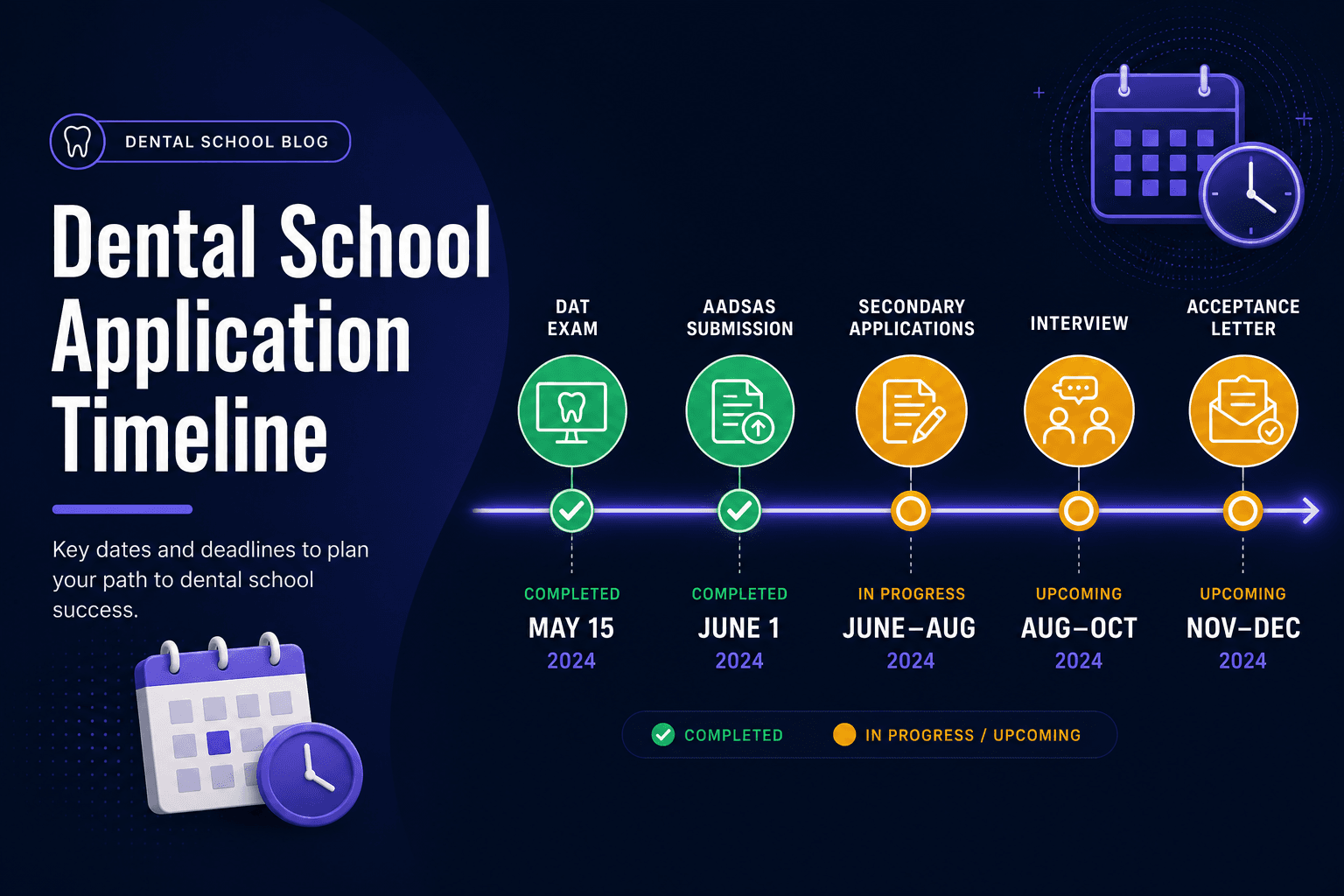
When Do Dental School Applications Open?
Quick answer (2026–27 cycle / Fall 2027 entry):
| Milestone | Date |
|---|---|
| AADSAS opens | May 12, 2026 |
| First submit day | June 2, 2026 |
| Decision Day (first acceptances) | December 15, 2026 |
Exact dates can shift slightly — confirm on the official AADSAS site — but the strategy does not: submit early.
Related timing questions:
- When does dental school start? Most U.S. programs matriculate in August.
- When do interviews start? Often August–March (rolling).
- When do acceptances come out? See Decision Day — Dec 15, 2026 for this cycle, then rolling into spring.
- April 30 is the common national deposit deadline.
Day-one checklist: When Does AADSAS Open?. Year-specific plan: Fall 2027 application timeline. Verification timing: How long does AADSAS verification take?. Fee help: AADSAS FAP. The rest of this guide is the full month-by-month plan.
The Biggest Mistake Pre-Dental Students Make Is Starting Too Late
Every year, qualified pre-dental students submit strong applications — and then don't hear back from a single school. Not because their GPA or DAT was too low. Not because their personal statement was weak. But because they submitted two or three months after the application opened, when most schools had already filled the majority of their interview slots.
Dental school admissions is rolling. That single word changes everything about how you should approach your timeline.
Rolling admissions means schools begin reviewing and inviting applicants to interview from the moment applications become complete — which is as early as late June. Schools don't wait until the deadline to evaluate everyone at once. They evaluate applicants continuously as they arrive, and they fill seats as they go.
A complete application submitted in June competes with a handful of other June applicants. The same application submitted in October competes with thousands — and many seats are already spoken for.
This guide gives you the exact month-by-month timeline you need to be a June applicant, not an October one.
Overview: The Full Dental School Application Cycle
Here is the complete application cycle for students applying to start dental school in the fall:
| Phase | Timeframe | Key Actions |
|---|---|---|
| Preparation | 12–18 months before matriculation | DAT prep, prerequisites, shadowing |
| DAT Exam | 12–15 months before matriculation | Take and pass the DAT |
| AADSAS Opens | Early May (application year) | Begin filling out application |
| AADSAS Earliest Submission | Early June | Submit primary application |
| Verification Complete | Late June – July | Application verified and sent to schools |
| Secondary Applications | July – October | Complete school-specific secondaries |
| Interviews | August – March | Attend dental school interviews |
| Acceptance Notifications | December – April | Receive decisions |
| Deposit Deadline | April 30 | Commit to one school |
| Matriculation | August | Begin dental school |
The most important date in the entire cycle: early June. That's when you want your primary application submitted — not the deadline, which is typically December or January. That window of 6+ months between early submission and deadline represents the difference between getting interviews and not getting them.
For the exact open-window checklist (what must be ready on day one), see When Does AADSAS Open?.
18 Months Before Matriculation (January–June, Junior Year)
Finalize Your Prerequisite Plan
Map out which science prerequisites you still need to complete and confirm they'll be done before you matriculate. Any in-progress courses at the time of application need to be clearly listed on AADSAS.
Review our dental school prerequisites guide to make sure your course list matches what your target schools require. Schools vary on specifics — check each one directly.
Begin Serious DAT Preparation
If you're targeting a June application submission, your DAT should ideally be taken no later than April or May of your application year. That means serious preparation needs to begin 10–14 weeks before your target test date — which puts the start of real prep at January or February of your junior year.
Many students underestimate how long DAT prep takes. A well-structured plan takes 10–12 weeks minimum. Rushing the DAT to hit the early submission window and scoring below your target is far worse than taking a few extra weeks and submitting in July.
Read our complete DAT study schedule to build your plan based on your current starting point.
Begin Identifying Recommenders
This is the most time-sensitive background task in your entire application. Letters of recommendation cannot be rushed — recommenders need 3–4 months to write a thoughtful letter. Start identifying your 3–4 recommenders now and begin building or strengthening those relationships.
Review our dental school letters of recommendation guide for a complete walkthrough of who to ask and when.
Start Building Your School List
Create a working list of 10–15 dental schools based on your current GPA, projected DAT score, geographic preferences, and mission alignment. This list will evolve — but having a working draft now lets you research each school's specific requirements, average accepted stats, and application deadlines.
12–15 Months Before Matriculation (February–May, Junior/Senior Year)
Take the DAT
Your target window: February through May for a June application submission. This gives you time to receive official scores (typically 3–5 business days after testing) before AADSAS opens.
If you score below your target on the first attempt, you have a decision to make: submit without the retake and update your application when improved scores arrive, or delay submission by 4–6 weeks to retake first. The right answer depends on how far below target you scored and how strong the rest of your application is.
One important rule: Do not rush the DAT just to hit an early submission date. A 19 submitted in June is not better than a 22 submitted in August. The DAT score is a major component of your competitiveness — optimize it first. If you already sat the exam and the score is below your school-list floor, read Should I Retake the DAT? before you re-register.
Formally Ask Your Recommenders
With your target submission date now firm, approach your recommenders formally — in person where possible. Give them at least 4 months of lead time from your target submission date.
Send each recommender a complete packet: your CV, personal statement draft, a brag sheet specific to your relationship with them, and clear AADSAS submission instructions. The more material you give them, the more specific and compelling their letter will be.
Draft Your Personal Statement
Start writing early. Your personal statement needs multiple drafts, external feedback, and time to breathe between revision sessions. A first draft in March gives you time for 4–6 rounds of revisions before your June submission target.
Read our dental school personal statement guide for a complete breakdown of what adcoms want to see and what to avoid.
Complete the Activities Section
AADSAS includes a detailed activities/experiences section where you list shadowing, research, volunteering, employment, leadership, and extracurriculars — with descriptions. Start compiling this information now. It takes longer than most applicants expect.
For each shadowing experience, have the dentist's name, practice name, dates, and total hours ready. For research, have your PI's contact information and a clear description of your role and findings.
10–12 Months Before Matriculation (May–June, Application Opening)
AADSAS Opens — Fill Out Every Section Immediately (Early May)
The AADSAS application typically opens in early May. The moment it opens, begin filling it out. You cannot submit until it opens, but you can complete every section in advance.
Work through:
- Personal information and contact details
- Academic history (every institution attended, every course taken)
- Standardized test scores (your DAT score should already be released)
- Experiences and activities
- Personal statement (paste your final draft)
- Dental school selections (finalize your list)
- Letters of recommendation assignments
The academic history section is the most time-consuming — you must manually enter every course from every institution, with grades and credit hours, exactly as they appear on your transcripts. Budget 4–6 hours for this section alone.
Request Official Transcripts (Early May)
Every institution where you completed coursework needs to send an official transcript to AADSAS. Request these in May — processing takes 1–4 weeks at most registrar offices. Transcript processing is the most common reason applications are delayed past the early submission window.
Request your transcripts the day AADSAS opens. Don't wait. Confirm the current cycle open date and day-one checklist in our guide: When Does AADSAS Open?.
Submit Your Application as Early as Possible (Early June)
Target date: first week of June.
This is the single most impactful action in your entire application. Early June applicants are reviewed first, interviewed first, and accepted first. Every week of delay after June costs you relative competitiveness in a rolling cycle.
Once you submit, AADSAS begins the verification process — cross-checking your self-reported coursework against your official transcripts. Verification typically takes 3–6 weeks during peak season. Your application is not transmitted to schools until verification is complete.
9–11 Months Before Matriculation (June–August)
Track Verification Status
After submission, log into AADSAS regularly to track your verification status. If AADSAS flags a discrepancy between your self-reported grades and your official transcripts, respond immediately. Delays in resolving discrepancies delay verification — which delays transmission to schools.
Secondary Applications Begin Arriving (Late June – July)
Once your primary application is verified and transmitted to schools, individual programs begin sending secondary applications. These are school-specific supplemental applications with additional essays, short-answer questions, and sometimes additional fees.
The critical rule with secondaries: Complete and return them within 2–3 weeks of receiving them. Schools track how quickly applicants respond to secondaries — a prompt response signals genuine interest and organizational ability.
Typical secondary essay prompts:
- Why do you want to attend our specific school?
- Describe a challenge you've overcome.
- How will you contribute to our school's mission?
- Tell us about a meaningful clinical or service experience.
Do not write generic secondaries. Every school-specific prompt deserves a school-specific answer. Research the program, its mission, its curriculum, and its student culture before writing a single word.
Prepare for Interviews
Interview invitations typically begin arriving in August and September for June applicants. Start preparing now — before the first invitation arrives.
Build your answer bank for the most common dental school interview questions. Schedule at least 2 mock interviews. Research every school you applied to so you can speak specifically about why you chose them.
Read our dental school interview prep guide for the 30 most common questions with sample answers and a structured 4-week prep plan.
6–9 Months Before Matriculation (August–November)
Interview Season
Interview invitations roll in from August through December for most programs. Some schools continue inviting into January or February.
What to do when you receive an invitation: Confirm your attendance immediately. Your promptness in accepting the invitation is noted. If you need to reschedule, do so as early as possible and for a legitimate reason only — rescheduling signals lower enthusiasm.
Day-of logistics:
- Arrive at least 15–20 minutes early
- Dress professionally and conservatively
- Bring printed copies of your application materials for reference
- Send a thank-you email to your interviewer within 24 hours
Continue Completing Secondaries
New secondary invitations may continue arriving into October and November, especially at schools that do more selective screening of who receives secondaries. Stay on top of your email and respond quickly to every new invitation.
Evaluate Your Application's Progress
By October, you should have a clear picture of which schools have sent you secondary invitations and which haven't. A pattern of schools not sending secondaries may signal a school-list calibration issue.
If you applied to 15 schools and have received secondaries from 12, your school list is reasonably well calibrated. If you've received secondaries from 3, something in your primary application needs to be reconsidered — either the list itself or the application components.
3–6 Months Before Matriculation (December–March)
Acceptance Notifications Begin
Many programs begin releasing acceptances starting in December. Others wait until January or later. The timing varies significantly by program.
If you receive an acceptance: Congratulations — but don't stop. Continue pursuing other applications and attending remaining interviews unless you're certain this is your top choice. You're allowed to hold multiple acceptances.
If you're waitlisted: This is not a rejection. Many students are admitted off waitlists — sometimes as late as August. Write a letter of continued interest to programs where you're waitlisted, update them on any meaningful developments in your application (improved grades, new experiences), and attend any remaining interviews at programs where you haven't yet been waitlisted.
If you haven't heard from a school by March: It's appropriate to contact admissions and inquire about your status. A brief, professional email is acceptable.
Consider Whether to Update Your Application
If your grades improved significantly, you completed meaningful new shadowing or clinical work, or you retook the DAT and improved your score, notify schools proactively. Send a brief update email to each school's admissions office.
April 30 — Commitment Deadline
By April 30, you must commit to one school and release all other acceptances. This date is standardized across AADSAS programs to prevent students from holding multiple seats indefinitely.
If you're still on a waitlist at your top-choice school as of April 30, you have a decision to make: commit to your in-hand acceptance while remaining on the waitlist (many schools allow this), or decline your acceptance to wait for the other school (riskier — only do this if you're confident you'll come off the waitlist).
What Happens If You Don't Get In This Cycle
Not matching in a given cycle is not the end. Many successful dentists applied multiple times before being accepted. The important thing is to understand specifically why you didn't match and build a deliberate plan to address it.
Common reasons for not matching:
- Late submission (missing the early applicant advantage)
- DAT score below program averages
- GPA below the competitive range for your school list
- School list not calibrated to your actual profile
- Interview performance (if you received interviews but no acceptances)
- Personal statement or secondary essays that didn't differentiate you
If you didn't receive interview invitations, the problem is in the primary application or school list. If you received interviews but no acceptances, the problem is in the interview performance or secondary essays.
In either case: get specific feedback, address the weak areas, and reapply with a stronger application. A free consultation with our admissions team can help you build an honest post-cycle analysis and a targeted plan for the next cycle.
Your 18-Month Master Checklist
18 Months Out
- Finalize prerequisite course plan
- Begin DAT prep (if targeting early exam)
- Identify potential recommenders and begin building relationships
- Start building target school list
12–15 Months Out
- Take the DAT (target: February–May)
- Formally ask recommenders — send complete materials packet
- Begin writing personal statement
- Compile activities/experiences list
10–12 Months Out (May–June)
- AADSAS opens — begin filling immediately
- Request official transcripts from all institutions
- Finalize and polish personal statement
- Finalize school list
- Submit primary application — target: first week of June
9–11 Months Out (June–August)
- Track verification status — resolve any discrepancies immediately
- Complete secondary applications within 2–3 weeks of receiving each
- Begin structured interview preparation
6–9 Months Out (August–November)
- Attend interviews — send thank-you notes within 24 hours
- Continue completing secondaries
- Evaluate secondary invitation pattern and adjust if needed
3–6 Months Out (December–March)
- Respond to acceptances, waitlists, and rejections
- Write letters of continued interest to waitlisted programs
- Send application updates where applicable
April 30
- Commit to one school — release all other acceptances
Frequently Asked Questions
When does AADSAS open each year?
AADSAS typically opens in early May each year. The exact date varies slightly — check the ADEA website annually for the confirmed date.
What is the AADSAS application deadline?
Most schools have deadlines between December and February. However, because admissions is rolling, submitting at the deadline puts you at a significant disadvantage compared to applicants who submitted in June.
Can I apply without having taken the DAT?
You can submit AADSAS without DAT scores, but your application cannot be complete until scores are received. Most programs won't review an application until all components — including DAT scores — are complete. Take the DAT before or immediately after submitting AADSAS.
How many dental schools should I apply to?
Most applicants apply to 10–18 schools. Fewer than 8 carries significant risk. More than 20 is generally unnecessary and expensive. Build a list with a mix of schools where you're above average, at average, and slightly below average for their entering class stats.
Can I apply to dental school and medical school in the same cycle?
Yes. AADSAS and AMCAS are separate application systems. Some applicants pursue both simultaneously. Be honest about your first choice in interviews for each — adcoms will ask.
What if I need to retake the DAT after submitting AADSAS?
You can submit your application and then have an improved DAT score added once it's available. Schools will update your file when new scores arrive. If your initial score is significantly below a school's average, it may be better to delay submission until improved scores are available.
The Bottom Line
The dental school application process rewards preparation and timing above almost everything else. A complete, polished application submitted in June will always outperform a slightly stronger application submitted in October — because the seats fill before October applicants are even being reviewed.
Start earlier than you think you need to. Submit earlier than you think you need to. And if you want expert guidance on building your strongest possible application for this cycle, schedule a free 15-minute call with our team.
We'll review your current timeline, identify the gaps, and make sure you're not leaving acceptances on the table because of a timing mistake that's entirely preventable.
Written By

Dr. Alexander Takshyn
DMD, Admissions Consultant & Founder