The Question That Trips Up Every First-Year Pre-Dental Student
You've decided you want to go to dental school. You're planning your undergraduate schedule. And then you open the admissions page of a dental school and see a list of required courses that looks intimidating, confusing, or both.
Do I need two semesters of biology or one? Does my AP Chemistry count? What is biochemistry listed as "recommended" rather than "required"? Will this online course count?
These are real questions — and getting the wrong answers early in your undergraduate career can create serious problems later. Taking the wrong courses, using AP credit where a school won't accept it, or missing a required lab sequence are mistakes that cost time, money, and sometimes an entire application cycle.
This guide gives you the complete, honest picture of dental school prerequisites — what's universally required, what varies by school, how grades in these courses affect your application, and how to build a smart course plan starting from your first semester.
Why Prerequisites Matter Beyond Just Checking Boxes
Before listing every required course, it's worth understanding what prerequisites actually accomplish in the admissions process.
They establish your academic foundation. Dental school coursework assumes you have a working knowledge of biology, chemistry, and physics at the undergraduate level. Prerequisites ensure you arrive at orientation ready to absorb first-year content — not catching up.
They test whether you can handle rigorous science coursework. The grades you earn in prerequisite courses are among the most heavily scrutinized in your application. A 4.0 in elective courses and a 3.0 in prerequisites is a red flag. A 3.5 across both signals consistent academic capability.
They signal commitment. Taking advanced science coursework — biochemistry, anatomy, physiology — beyond the minimum required shows intellectual engagement with the field, not just a checklist mentality.
The Universal Dental School Prerequisites
While every school has its own specific list, the following courses are required by the vast majority of accredited U.S. dental schools. If you complete all of these, you will meet the minimum prerequisite requirements for most programs.
Biology
Standard requirement: 2 semesters (1 year) of Biology with laboratory
This is the single most important prerequisite subject for dental school. You'll need introductory biology covering cell biology, genetics, evolution, and organismal diversity — typically Biology I and Biology II with accompanying lab sections.
What schools are looking for: Not just that you passed, but that you engaged with the material. A student who earned a B+ in Bio I and an A in Bio II with a lab demonstrates an upward trajectory. A student who took both courses pass/fail raises questions.
Upper-division biology: Many competitive programs either require or strongly recommend additional upper-division biology courses — Genetics, Cell Biology, Microbiology, or Physiology. Even if a school doesn't require them, taking one or two signals scientific depth.
General Chemistry
Standard requirement: 2 semesters (1 year) of General Chemistry with laboratory
General Chemistry I and II with labs is required by nearly every dental school. This covers atomic structure, stoichiometry, bonding, thermodynamics, kinetics, equilibrium, acids and bases, and electrochemistry.
Why it matters specifically: The BCP (Biology, Chemistry, Physics) GPA is calculated from these courses and weighted heavily in dental school admissions. Your performance in General Chemistry is a direct signal of your readiness for the basic sciences in dental school.
Organic Chemistry
Standard requirement: 2 semesters (1 year) of Organic Chemistry with laboratory
Organic Chemistry I and II with labs. This covers reaction mechanisms, functional group chemistry, stereochemistry, spectroscopy, and synthesis. Many students find this the most challenging prerequisite — and for good reason.
The DAT connection: Organic Chemistry is 30 of the 100 questions in the DAT's Survey of Natural Sciences section. Your performance in these courses prepares you directly for the DAT, making it one of the highest-leverage prerequisites in your schedule. Read our complete DAT study guide for how to connect your coursework to exam prep.
Physics
Standard requirement: 2 semesters (1 year) of Physics with laboratory
Most schools accept either calculus-based or algebra-based physics. Physics I typically covers mechanics, motion, energy, and waves. Physics II covers electricity, magnetism, light, and optics.
Important note: Many pre-dental students take algebra-based physics, which is generally accepted everywhere. If you're a strong math student, calculus-based physics won't hurt — but it's not required for admissions.
English / Writing
Standard requirement: 2 semesters (1 year) of English composition or writing-intensive coursework
Dental schools include English because effective written and verbal communication is a core professional competency. Patient education, treatment explanations, clinical documentation — all require clear communication.
Most programs accept English Composition I and II, or one composition course plus a writing-intensive course in another discipline (literature, humanities, social science).
Mathematics
Standard requirement: 1 semester of college-level mathematics (varies significantly by school)
This is the most variable prerequisite. Requirements range from Pre-calculus to Calculus I to Statistics. Some programs accept any college-level math course; others specifically require calculus or statistics.
Best approach: Take Calculus I and one semester of Statistics. This satisfies nearly every school's math requirement and demonstrates quantitative ability beyond the minimum.
Commonly Required or Strongly Recommended Additional Courses
Beyond the universals above, the following courses appear on many school-specific prerequisite lists — and carrying these on your transcript, even when not strictly required, strengthens your application.
Biochemistry
Status: Required by many top programs; recommended by most others
Biochemistry is increasingly listed as a requirement rather than a recommendation by competitive programs. It bridges general chemistry and biology directly — exactly the foundation dental school biochemistry courses build on. If you're serious about applying to top-tier programs, take biochemistry.
Microbiology
Status: Required by some; recommended by most
Understanding microbiology is clinically relevant to dentistry — oral bacteria, infection control, antibiotic pharmacology. Many programs require it or give preference to applicants who have completed it.
Anatomy or Physiology
Status: Recommended by most; required by some
Human Anatomy and/or Physiology are listed as recommended prerequisites at many programs and directly relevant to dental school gross anatomy — a notoriously demanding first-year course. Taking these before dental school gives you a significant advantage in year one.
Statistics
Status: Required or recommended at a growing number of programs
Evidence-based dentistry requires the ability to interpret research data. Statistics is increasingly expected, and some programs now list it as a formal requirement.
Psychology or Sociology
Status: Required by some; recommended by others
Understanding patient behavior, anxiety management, and social determinants of health is part of modern dental education. Some programs — particularly those with community health missions — require at least one social science course.
Course-by-Course Prerequisite Checklist
Use this as your planning reference:
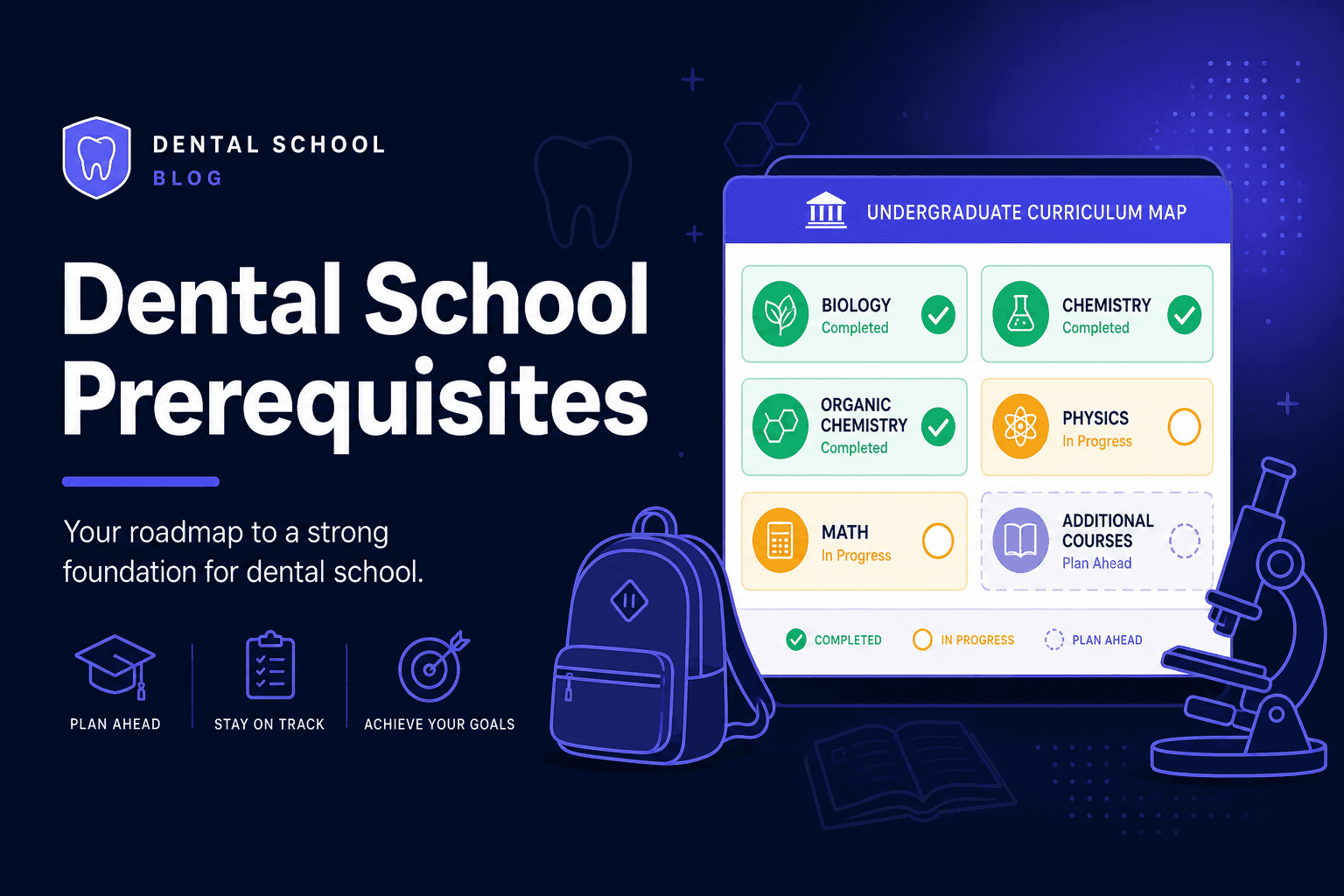
| Course | Semesters | Lab Required? | Priority |
|---|---|---|---|
| Biology I & II | 2 | Yes | Essential |
| General Chemistry I & II | 2 | Yes | Essential |
| Organic Chemistry I & II | 2 | Yes | Essential |
| Physics I & II | 2 | Yes | Essential |
| English Composition | 2 | No | Essential |
| Mathematics (Calculus or Statistics) | 1–2 | No | Essential |
| Biochemistry | 1 | Sometimes | Strongly Recommended |
| Microbiology | 1 | Sometimes | Recommended |
| Anatomy / Physiology | 1–2 | Sometimes | Recommended |
| Statistics | 1 | No | Recommended |
| Psychology or Sociology | 1 | No | Recommended |
Total minimum credits: Approximately 60–70 credit hours of required and recommended prerequisite coursework. This represents roughly half of a typical 120-credit undergraduate degree.
How AP and IB Credits Are Handled
This is one of the most common points of confusion — and getting it wrong is costly.
The general rule: Most dental schools do not accept AP or IB credits to satisfy prerequisite requirements. They want to see you complete these courses at the university level, under the academic rigor of a college classroom, with a grade on your official transcript.
The exception: A minority of programs will accept AP credit for introductory prerequisites like English or Calculus — but almost never for Biology, Chemistry, or Physics.
What this means for you: Even if you placed out of introductory Biology or Chemistry through AP credit, you likely still need to take the college-level courses to satisfy dental school prerequisites. Do not assume AP credit satisfies a requirement without checking each school's specific policy.
The silver lining: Students who earned high AP scores and then retake the subject at the university level often do very well — they're covering familiar material with greater maturity and stronger study skills, which helps their prerequisite GPA.
Online Courses and Community College Credits
Online Prerequisite Courses
Post-pandemic, this policy has evolved. Some dental schools now explicitly accept online prerequisite courses — particularly for lecture components. However:
- Laboratory requirements almost universally must be completed in person
- Many competitive programs still prefer or require in-person coursework
- If you complete online prerequisites, check each school's current policy individually
Best practice: Complete prerequisites at a four-year university if at all possible. If you use community college or online courses for one or two prerequisites, compensate with strong performance in upper-division courses at your home institution.
Community College Prerequisites
Accepted at many programs — but with caveats. Some schools specifically require that a certain number of prerequisite courses be completed at a four-year accredited institution. Others accept all accredited college coursework regardless of institution type.
If finances or scheduling require taking some prerequisites at community college, research your target schools' specific policies before registering. Taking all prerequisites at a community college and applying to top programs puts your application at a disadvantage.
When to Take Each Course: A Suggested Pre-Dental Timeline
Planning your prerequisite sequence matters — both for your GPA and for DAT preparation. Here's a logical 4-year framework:
Freshman Year
- Biology I and II (with labs)
- General Chemistry I and II (with labs)
- English Composition I and II
- Mathematics (Calculus I or Statistics)
Why this order: Biology and General Chemistry first gives you the foundation for Organic Chemistry, which builds directly on both. Taking these in year one ensures you have time for additional upper-division courses later.
Sophomore Year
- Organic Chemistry I and II (with labs)
- Physics I and II (with labs)
- One elective biology course (Genetics, Cell Biology)
Why this order: Organic Chemistry builds on General Chemistry. Physics can run concurrently. By end of sophomore year, most core prerequisites are complete — giving you junior and senior years for upper-division courses, research, and DAT prep.
Junior Year
- Biochemistry
- Microbiology or Anatomy/Physiology
- Statistics
- Psychology or Sociology
- Begin DAT preparation (target late junior year or summer before senior year)
Senior Year
- Upper-division biology electives
- Finalize shadowing hours
- Submit AADSAS application (ideally June–July of senior year)
- Complete secondary applications
The Grades That Matter Most
Not all prerequisite grades carry equal weight in your application.
Highest scrutiny: Biology, General Chemistry, Organic Chemistry — these form your BCP (Biology, Chemistry, Physics) GPA, calculated separately on AADSAS and reviewed closely by every program.
High scrutiny: Physics, Biochemistry — especially at research-focused programs.
Moderate scrutiny: English, Mathematics — reviewed as part of total and non-science GPA.
What this means practically: If you have limited time and energy in a given semester, prioritize performance in your BCP courses above all others. A B in English with an A in Organic Chemistry is a much stronger signal than the reverse.
What to Do If You Perform Poorly in a Prerequisite
Do not ignore it and move on. A C or D in Organic Chemistry doesn't disappear — it sits on your AADSAS transcript and in your BCP GPA calculation forever.
Your options:
- 1Retake the course — both grades appear on AADSAS, but an A after a C shows remediation and growth. Most programs view a strong retake positively if accompanied by an explanation.
- 2Supplement with advanced coursework — strong grades in Biochemistry or upper-division Chemistry courses demonstrate you've mastered the underlying material.
- 3Address it in your application — the additional information section of AADSAS exists for exactly this purpose. A brief, honest explanation of what happened and what changed is better than leaving the adcom to draw their own conclusions.
Checking Prerequisites School by School
Because requirements vary, always verify directly against each school's admissions page before submitting your application.
What to look for on each school's page:
- The specific courses they require (not just subject areas)
- Whether labs are required for each course
- Whether online or community college coursework is accepted
- Whether AP/IB credit satisfies any requirements
- The minimum grade required in prerequisite courses (many require a C or better)
- Prerequisite completion deadlines (some require completion before application; others allow completion during the application year)
The ADEA Official Guide to Dental Schools is published annually and lists prerequisite requirements for every accredited U.S. program in one place. It's an invaluable planning resource.
Frequently Asked Questions
Can I apply to dental school before finishing all prerequisites?
Yes — most schools allow you to apply with prerequisites in progress, as long as you complete them before matriculation. Clearly list any in-progress courses on your AADSAS application. Do not leave them off.
What if I'm a non-traditional applicant who graduated years ago?
Prerequisite courses taken 10+ years ago may be flagged as outdated by some programs, particularly in rapidly evolving fields like biochemistry and cell biology. If you graduated more than 7–10 years ago, consider retaking or supplementing older prerequisites with recent coursework.
Do I need a science degree to apply to dental school?
No. Dental schools do not require a specific major — they require specific courses. A student who majored in Music and completed all required science prerequisites is eligible to apply. That said, a science-related major often makes prerequisite planning more straightforward.
What is the minimum grade accepted in prerequisite courses?
Most programs require a C or better in each prerequisite course. Some competitive programs expect B or better. Any grade below C in a prerequisite course is a serious flag and should be addressed through retaking the course.
Does biochemistry replace one of the chemistry prerequisites?
No. Biochemistry is an additional course that complements — not replaces — General Chemistry and Organic Chemistry requirements. All three are distinct prerequisites at schools that require biochemistry.
How many total prerequisite credit hours do I need?
Minimum requirements typically add up to 60–70 credit hours, though completing recommended courses (Biochemistry, Anatomy, Statistics, etc.) may bring the total to 80–90. This is roughly half of a standard 120-credit undergraduate degree.
Your Prerequisite Action Plan
Here is what to do based on where you are right now:
If you're a freshman: Map out a 4-year course plan this semester. Meet with your pre-health advisor. Front-load the biology and chemistry sequence. Confirm with your top 5 target schools that your planned coursework satisfies their specific requirements.
If you're a sophomore or junior: Audit what you've completed against the checklist above. Identify any gaps and schedule the missing courses. Start thinking about when you'll take the DAT and work backward from there.
If you're a senior or post-bacc: Complete any remaining prerequisites before your application cycle deadline. Identify any weak prerequisite grades that need to be addressed — either through retaking or supplementing with advanced coursework.
Wherever you are: Research your specific target schools. Prerequisites vary enough between programs that a course that satisfies School A may not satisfy School B. Build your plan around the most demanding school on your list — if you meet their requirements, you meet everyone else's.
If you'd like a personalized review of your current coursework and how it maps to the specific schools you're targeting, schedule a free call with our team. We'll identify any gaps before they become problems.
Written By

Dr. Alexander Takshyn
DMD, Admissions Consultant & Founder