
Your Odds of Getting Into Dental School — The Honest Numbers
Every pre-dental student wants to know the same thing: What are my chances?
The answer depends on factors most students either don't know or underestimate. And the most dangerous mistake you can make is building a school list based on gut feeling rather than actual data.
Here is what the numbers actually show.
According to the American Dental Education Association (ADEA), approximately 55,000–60,000 applications are submitted to U.S. dental schools annually through AADSAS. Across all 67 accredited programs, dental schools collectively enroll approximately 6,700–7,000 new students each year.
That works out to an overall national acceptance rate of roughly 11–13% — meaning that across all applications submitted to all programs, about 1 in 8–9 is accepted.
But that aggregate number is nearly useless for planning your own application. Individual school acceptance rates range from 3% to 35%, and an applicant with a 3.7 GPA and a 22 DAT faces completely different odds than an applicant with a 3.2 GPA and an 18 DAT — even at the same school.
This guide gives you the actual data by school tier, explains what separates accepted from rejected applicants with similar stats, and shows you how to build a school list that gives your real profile a real chance.
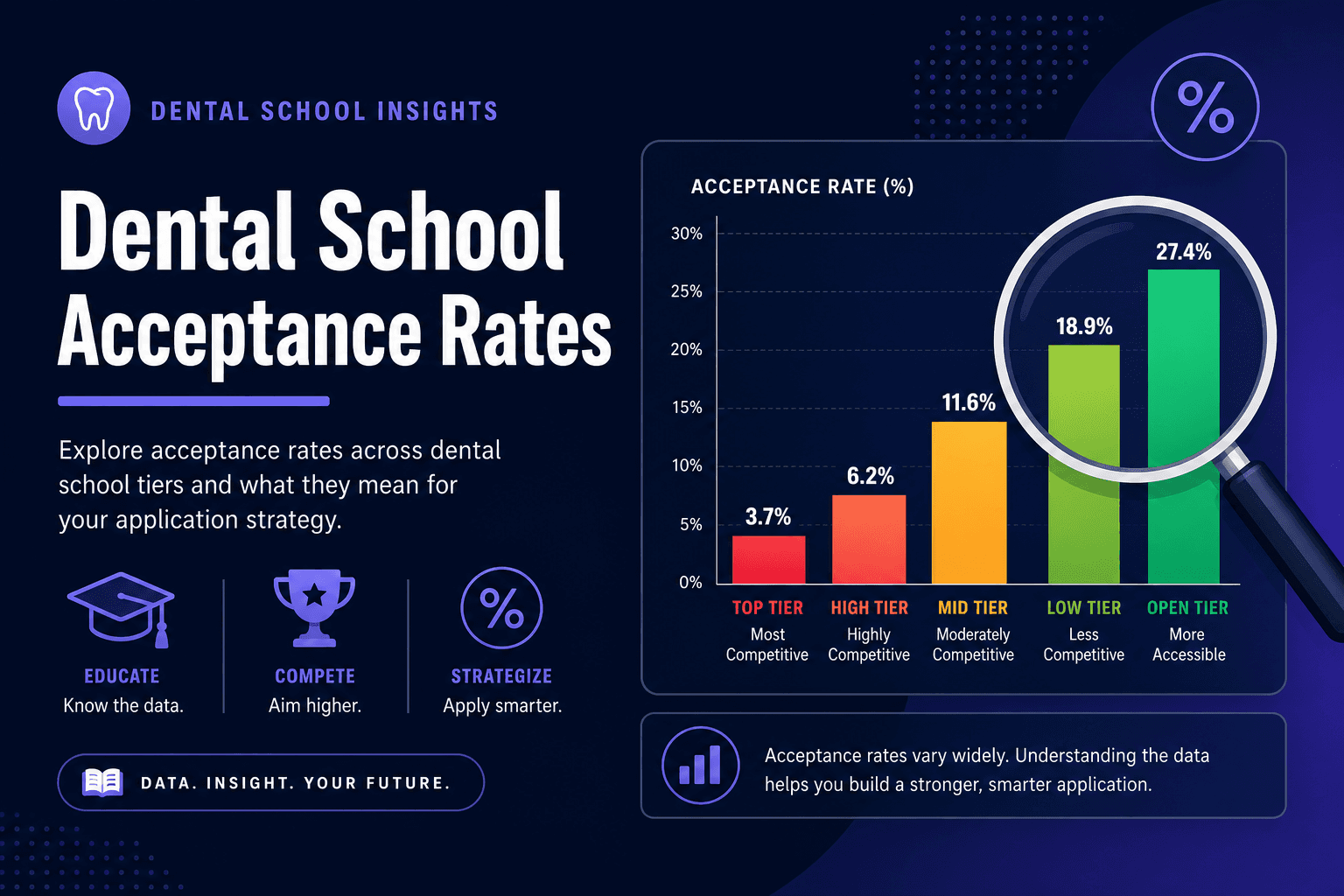
National Acceptance Rate by School Tier
Not all dental schools are equally selective. Understanding the tier structure helps you calibrate your expectations and build a balanced list.
Tier 1: Most Competitive Programs
These are the programs with the highest applicant volume and the most selective admissions. Most are private institutions with strong research reputations or historically prestigious programs.
| School | Approximate Acceptance Rate | Mean AA DAT | Mean GPA |
|---|---|---|---|
| Harvard School of Dental Medicine | 3–4% | 23–24 | 3.8+ |
| Columbia University College of Dental Medicine | 4–5% | 22–23 | 3.75+ |
| University of Pennsylvania (Penn Dental) | 5–7% | 22–23 | 3.7+ |
| UCSF School of Dentistry | 5–7% | 22–23 | 3.7+ |
| University of Michigan | 6–8% | 21–22 | 3.65+ |
| NYU College of Dentistry | 7–9% | 20–22 | 3.6+ |
Applicants at these programs typically have GPAs in the top 10–15% of all dental applicants and DAT scores at the 95th percentile or above. Being competitive here means being exceptional — not just qualified.
Tier 2: Highly Competitive Programs
Strong research programs, well-regarded clinically, with meaningful selectivity. Most top applicants target programs in this tier as their primary aspirational schools.
| School Type | Approximate Acceptance Rate | Mean AA DAT | Mean GPA |
|---|---|---|---|
| Top public programs (in-state) | 8–14% | 20–22 | 3.55–3.7 |
| Top public programs (out-of-state) | 4–8% | 21–23 | 3.6–3.75 |
| Competitive private programs | 8–15% | 20–22 | 3.5–3.7 |
Tier 3: Moderately Competitive Programs
These programs have meaningful acceptance rates and represent the core of a well-balanced school list for most applicants. They still require a strong application — but the bar is achievable for prepared candidates.
| School Type | Approximate Acceptance Rate | Mean AA DAT | Mean GPA |
|---|---|---|---|
| Mid-tier private programs | 12–22% | 19–21 | 3.4–3.6 |
| Mid-tier public programs (in-state) | 15–25% | 19–21 | 3.4–3.6 |
Tier 4: Accessible Programs
These programs have higher acceptance rates and/or a mission to serve specific populations (rural communities, underrepresented minorities, students from their state). They often receive fewer qualified applications relative to their seat count.
| School Type | Approximate Acceptance Rate | Mean AA DAT | Mean GPA |
|---|---|---|---|
| Newer or access-mission schools | 20–35% | 17–20 | 3.0–3.4 |
| Schools with specific mission alignment | 18–30% | 18–20 | 3.2–3.5 |
Important caveat: An acceptance rate of 25% does not mean 1 in 4 applicants gets in. It means 1 in 4 complete applications receives an acceptance. Many applicants submit incomplete files, apply with severely below-average stats, or apply to programs for which they have no realistic chance — inflating the denominator. A prepared applicant with a calibrated school list should expect higher personal odds than the school's headline acceptance rate.
What the Acceptance Rate Doesn't Tell You
The single acceptance rate figure published for each school hides several critical nuances.
In-State vs. Out-of-State
Public dental schools heavily favor in-state residents. At most public programs, in-state applicants represent 60–85% of the entering class despite being a smaller share of total applicants. The effective out-of-state acceptance rate at many public programs is 3–6%, even if their overall rate appears higher.
Implication: If you're applying out-of-state to public programs, treat them as aspirational and apply broadly. Your in-state public program should almost always be on your list — read our guide on how to pay for dental school to see why the financial benefit compounds this strategic advantage.
First-Time vs. Repeat Applicants
Repeat applicants — students reapplying after a rejected cycle — often face harder acceptance odds in subsequent cycles if they have not meaningfully strengthened their application. Schools track reapplicants and expect to see documented growth. A repeat applicant with the same application as last year is not more competitive; they're less so.
If you're planning to reapply, the improvements need to be real and visible: improved DAT score, post-bacc coursework, additional clinical experience, stronger letters, and an updated personal statement that directly addresses what changed.
Early vs. Late Applicants
In a rolling admissions cycle, submission timing directly affects your effective acceptance rate. An applicant who submits in June is competing for a full seat pool. An applicant who submits in October is competing for whatever seats remain after 4 months of rolling acceptances.
Submitting in the first two weeks of AADSAS opening can increase your effective odds by 30–50% compared to submitting in October — not because your application changed, but because the competition changes. See our dental school application timeline guide for the exact dates that matter, and When Does AADSAS Open? for the day-one readiness checklist.
The Stats That Actually Predict Acceptance
Acceptance rates tell you how competitive a program is. Your own stats tell you how competitive you are within that pool. Here's how to read both together.
GPA and DAT: The Initial Screen
Every dental school has an initial screening threshold — a minimum GPA and DAT score below which applications typically aren't advanced to full review. These thresholds are rarely published but can be inferred from each school's 10th percentile accepted applicant data.
General rule: Apply to schools where your GPA and DAT are at or above their 25th percentile entering class stats — not just above their stated minimum. Being at the 25th percentile means 75% of accepted students were stronger than you on paper — but you're still in the realistic pool. Being at the 10th percentile means 90% were stronger — much harder to compensate.
The Holistic Review Factors
Once your application clears the initial screen, schools move to holistic review. At this stage, the following factors meaningfully differentiate candidates with similar GPA and DAT scores:
Clinical experience and shadowing depth: Not just hours — quality of exposure. A student who shadowed across three settings (general dentistry, OMFS, community health) with 180 hours tells a richer story than 180 hours with a single family dentist. Read our dental shadowing guide for how to maximize this.
Personal statement quality: The most consistently undervalued component. Two applicants with identical GPA and DAT scores — one with a generic personal statement and one with a specific, compelling narrative — do not have equal odds. Read our personal statement guide for what actually differentiates a compelling statement.
Letters of recommendation: Generic letters from professors who barely know you don't add to your competitiveness. Specific, enthusiastic letters from people who know your character and clinical curiosity do. Read our letters of recommendation guide.
Interview performance: At schools where you receive an interview, it becomes the primary differentiator. Among interviewed candidates, interview performance explains more variance in outcomes than any other factor. Read our interview preparation guide.
Mission alignment: Schools with specific missions — community health, research, underserved populations — actively select for applicants who demonstrate genuine alignment. Applying to these schools without demonstrating mission fit in your application is a wasted application.
How to Build a Balanced School List Based on Acceptance Rate Data
The strategic principle: your list should give you multiple realistic acceptances — not just maximize the chance of one.
The 3-Tier List Framework
Aspirational schools (3–4 schools): Programs where your GPA and DAT are slightly below their 50th percentile but you have a compelling application overall. You wouldn't be surprised to be rejected, but you'd be genuinely competitive if everything clicks.
Target schools (6–8 schools): Programs where your GPA and DAT are at or above their 50th percentile. These are your most realistic acceptances — schools where a well-executed application should yield interview invitations and meaningful consideration.
Safety schools (3–4 schools): Programs where your stats are comfortably above their 75th percentile. These should be near-certainties if your application is complete and professional. Every school list needs genuine safety schools — not just programs you think are less competitive.
Total: 12–16 programs. Fewer than 10 carries meaningful risk of no acceptances in a given cycle. More than 18–20 is financially unnecessary and logistically difficult to execute well (each secondary application requires school-specific effort).
Finding Each School's Real Stats
For each program you're considering, find their most recently published entering class profile. Look for:
- Mean overall GPA and mean BCP GPA
- 10th–90th percentile GPA range
- Mean DAT score by section
- Percentage of in-state vs. out-of-state students in the entering class
- Total applicants and total enrolled (to calculate real acceptance rate)
Where to find this data:
- Each school's official admissions page (search "entering class profile" or "class of [year] statistics")
- ADEA's Official Guide to Dental Schools (updated annually)
- Student Doctor Network (SDN) dental school-specific forums — applicant data self-reported by cycle
Red Flags in Your School List
All top-20 programs, no safety schools. This is the most common list-building mistake. It signals either overconfidence or unfamiliarity with the admissions landscape.
Only in-state schools. If your in-state program is highly competitive and your stats are borderline, applying only there creates single-point-of-failure risk. Applying out-of-state to programs where you're a stronger candidate adds meaningful insurance.
No mission alignment research. Programs with community health or rural service missions actively prefer candidates who demonstrate genuine alignment. Applying to these programs without tailoring your application to their mission is leaving competitive advantage on the table.
Geographic clustering. If you're applying to 12 schools all in the same region, you're limiting your pool unnecessarily. Dental schools serve regional employment markets, and some regions have much higher applicant-to-seat ratios than others.
What Separates Accepted Applicants From Rejected Ones With Similar Stats
After working with hundreds of dental school applicants, I can tell you the patterns are remarkably consistent.
Rejected applicants with strong stats most commonly:
- Submitted late in the rolling cycle (September–November instead of June–July)
- Had a school list that was systematically too ambitious for their profile
- Wrote a generic personal statement that didn't differentiate them
- Had shadowing hours but nothing specific or insightful to say about them
- Received weak letters from recommenders who didn't know them well
- Struggled to articulate specifically why they chose each program they applied to
Accepted applicants with borderline stats most commonly:
- Submitted in the first two weeks AADSAS opened
- Had a carefully calibrated school list with genuine safety schools
- Wrote a personal statement that told a specific, memorable story
- Could discuss clinical observations with depth and genuine insight
- Had at least one letter that was enthusiastic and specific
- Interviewed exceptionally well — this is where borderline applicants most often win
The statistic that surprises most pre-dental students: interview conversion rate (the percentage of interviewed applicants who receive acceptances) typically ranges from 30–60% across programs. That means even after receiving an interview — a significant positive signal — most applicants are still not accepted. Interview preparation is not optional; it's the final and most high-stakes phase of the process.
Acceptance Rate FAQ
What is the overall dental school acceptance rate in the US?
Approximately 11–13% of all applications submitted result in an acceptance. However, this figure aggregates across all programs and all applicants — including many who apply with severely below-average stats or apply far outside their realistic range. A well-prepared applicant with a calibrated school list should expect meaningfully higher personal odds.
Which dental school has the highest acceptance rate?
Acceptance rates vary by year and are not always publicly reported in detail. Generally, newer programs, programs with community health missions, and programs in regions with fewer applicants have higher acceptance rates — often 20–35%. Always verify current data on each school's official admissions page.
Which dental school is the hardest to get into?
Harvard, Columbia, Penn, and UCSF consistently have the lowest acceptance rates (3–7%) and the highest entering class stats. Competition at these programs is among the most intense of any graduate professional program in the United States.
Can I get into dental school with a 3.3 GPA?
Yes — at the right programs. A 3.3 GPA paired with a 21+ DAT, strong clinical experience, and a compelling personal statement is a competitive profile at many accredited programs. The key is building a school list calibrated to your actual stats rather than aspirational programs where your GPA is below the 10th percentile. Read our dental school GPA guide for a detailed breakdown.
Does applying to more schools increase your chances?
Yes, up to a point. Applying to 15 well-chosen schools dramatically increases your overall acceptance probability compared to applying to 5. But applying to 25 schools doesn't meaningfully improve on 15–18 — and it increases secondary application burden to the point where quality of each application declines. The sweet spot for most applicants is 12–16 carefully chosen programs.
How many dental schools should I apply to if I'm a reapplicant?
Reapplicants should generally apply to at least 14–18 schools — slightly more than first-time applicants — because they already know they struggled in the previous cycle. More importantly, reapplicants should apply earlier and with demonstrably stronger applications. Reapplying with the same application is rarely effective.
Your Action Plan: Using Acceptance Rate Data to Build Your List
Step 1 — Get your baseline stats in order.
Know your exact overall GPA, BCP GPA, and DAT score by section. These three numbers define your initial competitive range.
Step 2 — Pull the entering class data for every school on your initial list.
For each school, find their mean GPA, mean DAT, and acceptance rate. Note whether they're public or private, and what percentage of their class is in-state.
Step 3 — Categorize each school as aspirational, target, or safety.
Based on where your stats land relative to each school's 25th/50th/75th percentile, classify every school. Make sure you have at least 3–4 genuine safety schools.
Step 4 — Research mission alignment for each program.
For every school on your list, spend 15 minutes on their website understanding their mission, curriculum philosophy, and community commitments. Identify which aspects genuinely align with your background and goals — this shapes your secondary applications.
Step 5 — Submit early.
Everything else being equal, submitting in the first week of AADSAS opening is the single highest-leverage action available to any applicant. Don't undermine a strong application by submitting it 3 months after the cycle opens.
Sources & Further Reading
- ADEA / AADSAS official applicant resources and dental school guides
- Individual dental school admissions pages (entering class profiles and requirements)
- ADA education resources for prospective dental students
Last reviewed: July 23, 2026. Acceptance rates and class profiles change yearly — verify current figures on each school’s official site before finalizing your list.
If you'd like a personalized school list review based on your specific GPA, DAT score, clinical experience, and state of residency, schedule a free call with our team. We'll evaluate your profile against current program data and help you build a list that maximizes your chances of at least one — and ideally several — acceptances.
Written By

Dr. Alexander Takshyn
DMD, Admissions Consultant & Founder