
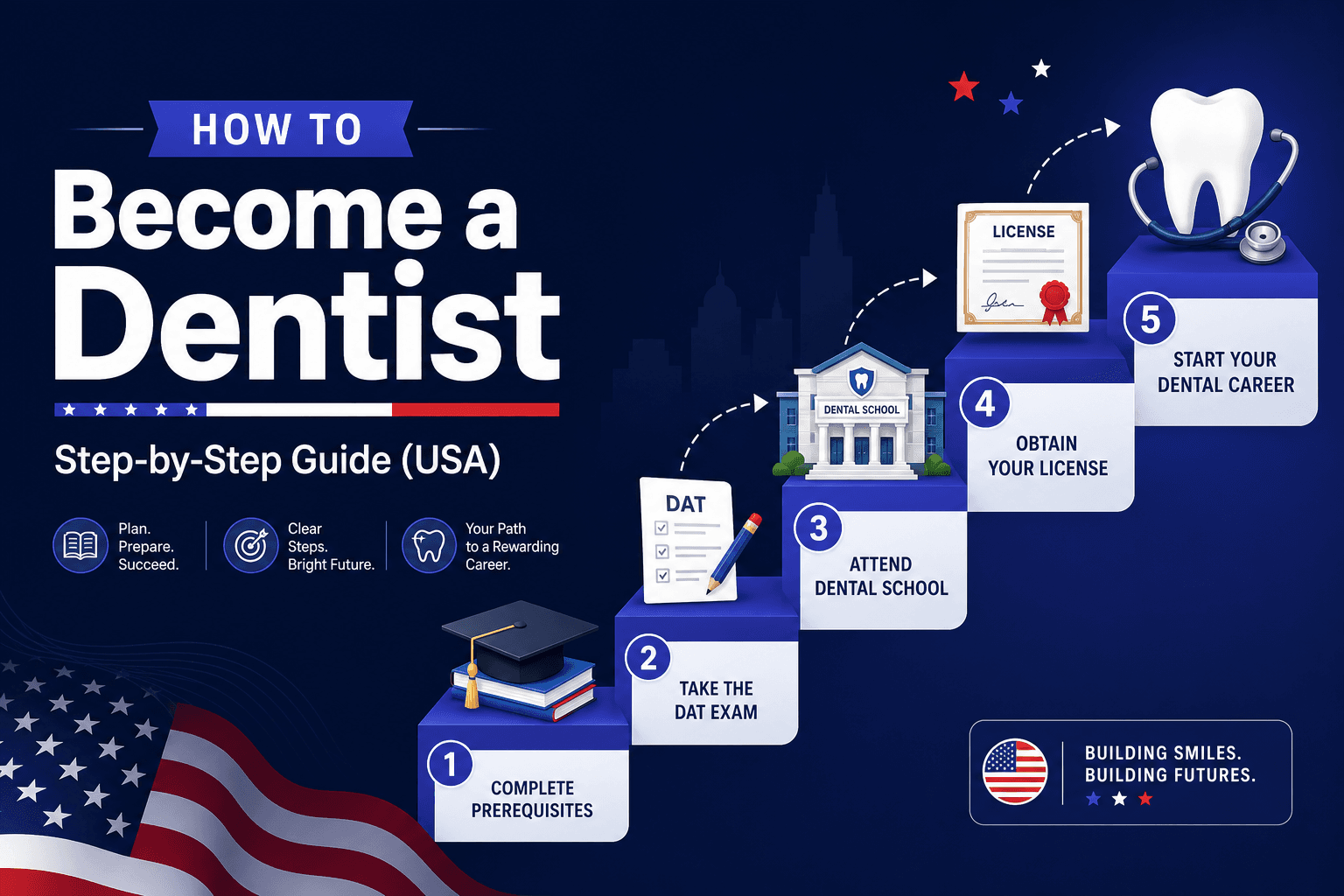
The Short Answer: 8 Years Minimum
How long does it take to become a dentist in the U.S.? For most people: about 8 years after high school —
- 4 years undergraduate (bachelor’s + prerequisites)
- 4 years dental school (DDS or DMD)
- Then licensure (exams + state requirements) before you can practice
That 8-year figure is the standard path to becoming a general dentist. Specialty training (orthodontics, oral surgery, etc.) adds 2–6 more years. Gap years, retakes, or delayed applications can stretch the timeline further.
If you want the full how (prerequisites, DAT, AADSAS, interviews), use our process guide: How to become a dentist in the USA. This page answers the duration question only.
Step 1: Undergrad Prerequisites (4 Years)
Most applicants complete a 4-year bachelor’s degree while finishing dental school prerequisites (biology, general/organic chemistry, physics, often biochemistry, English, and sometimes math/stats).
| What you’re doing | Typical time |
|---|---|
| Bachelor’s degree | ~4 years |
| Shadowing + experiences | Alongside undergrad (often Years 2–4) |
| DAT prep + exam | Usually junior year or early senior year |
| AADSAS application | Summer before / of senior year |
You do not need a biology major — but you do need the science prerequisites and a competitive GPA / DAT.
Can undergrad be shorter? Sometimes — heavy AP/IB credit, summer terms, or rare accelerated tracks. Most students still land near four academic years before dental school matriculation.
Step 2: Dental School — DDS/DMD (4 Years)
U.S. dental school is almost always four years:
| Years | Focus |
|---|---|
| D1–D2 | Biomedical sciences, preclinical skills, early patient exposure |
| D3–D4 | Clinical dentistry, patient care, competency requirements |
DDS and DMD are equivalent — the degree name depends on the school, not prestige or length.
After graduation you still need licensure (national/regional clinical exams + state rules) before independent practice. Licensure timing is usually weeks to a few months after graduation if you plan ahead — not another full academic year, but it is a real step on the clock.
For the admissions-cycle calendar (when AADSAS opens, secondaries, interviews), see the dental school application timeline — that is a different “timeline” (one application year), not total years to become a dentist.
Optional: Specialization / Residency (2–6 More Years)
| Path | Extra time after dental school |
|---|---|
| General dentist (no residency required) | 0 — license and practice |
| Many specialties (e.g., endo, perio, ortho, peds) | Often 2–3 years |
| Oral & maxillofacial surgery | Often 4–6 years (program-dependent) |
If your goal is “practicing dentist,” count ~8 years. If your goal is a named specialty, plan ~10–14 years total after high school.
Can You Speed It Up? (Accelerated & 3+4 Programs)
Ways people shorten the path (without skipping dental school):
- 13+4 / BS-DDS linked programs — compressed undergrad + guaranteed or preferred dental seat if you meet benchmarks (highly competitive; not available everywhere)
- 2AP / dual-enrollment credit — finish bachelor’s requirements faster
- 3No gap year — apply on-cycle and matriculate the summer after graduation
- 4Strong first-pass DAT — avoid retake delays (should you retake?)
What you cannot skip: the accredited 4-year DDS/DMD (unless you are an internationally trained dentist in an Advanced Standing pathway — typically 2–3 years, different route).
Full Timeline Chart, Year by Year
Example path for a student who goes straight through with no gap year:
| Year | Stage |
|---|---|
| 1–4 | Undergrad + prerequisites + shadowing |
| ~3–4 | DAT + [AADSAS](/blog/when-does-aadsas-open) application cycle |
| 5–8 | Dental school (D1–D4) |
| End of Year 8 | Graduate → licensure → general practice |
| 9+ | Optional specialty residency |
With one gap year (common for DAT retake, grades, or experiences): add ~1 year → ~9 years to practice.
With specialty training: add residency length on top of Year 8.
FAQ
How many years of dental school? Almost always 4 years for DDS/DMD in the U.S.
Is it 8 years including high school? No — the common “8 years” means after high school (4 undergrad + 4 dental school).
How long to become an orthodontist / oral surgeon? Dental school first (~8 years path to DDS/DMD), then specialty training (often 2–3 for many specialties; oral surgery often longer).
Does residency add required years for general dentists? No. General dentists can license and practice after dental school without a residency.
What’s the difference between this and the application timeline? Application timeline = one admissions cycle. This page = total years from college start to practicing dentist.
Next Step
Know the years — then execute the steps. Start here: How to become a dentist in the USA.
Want a timeline built around your GPA, DAT date, and school list? Schedule a free call.
Written By

Dr. Alexander Takshyn
DMD, Admissions Consultant & Founder