
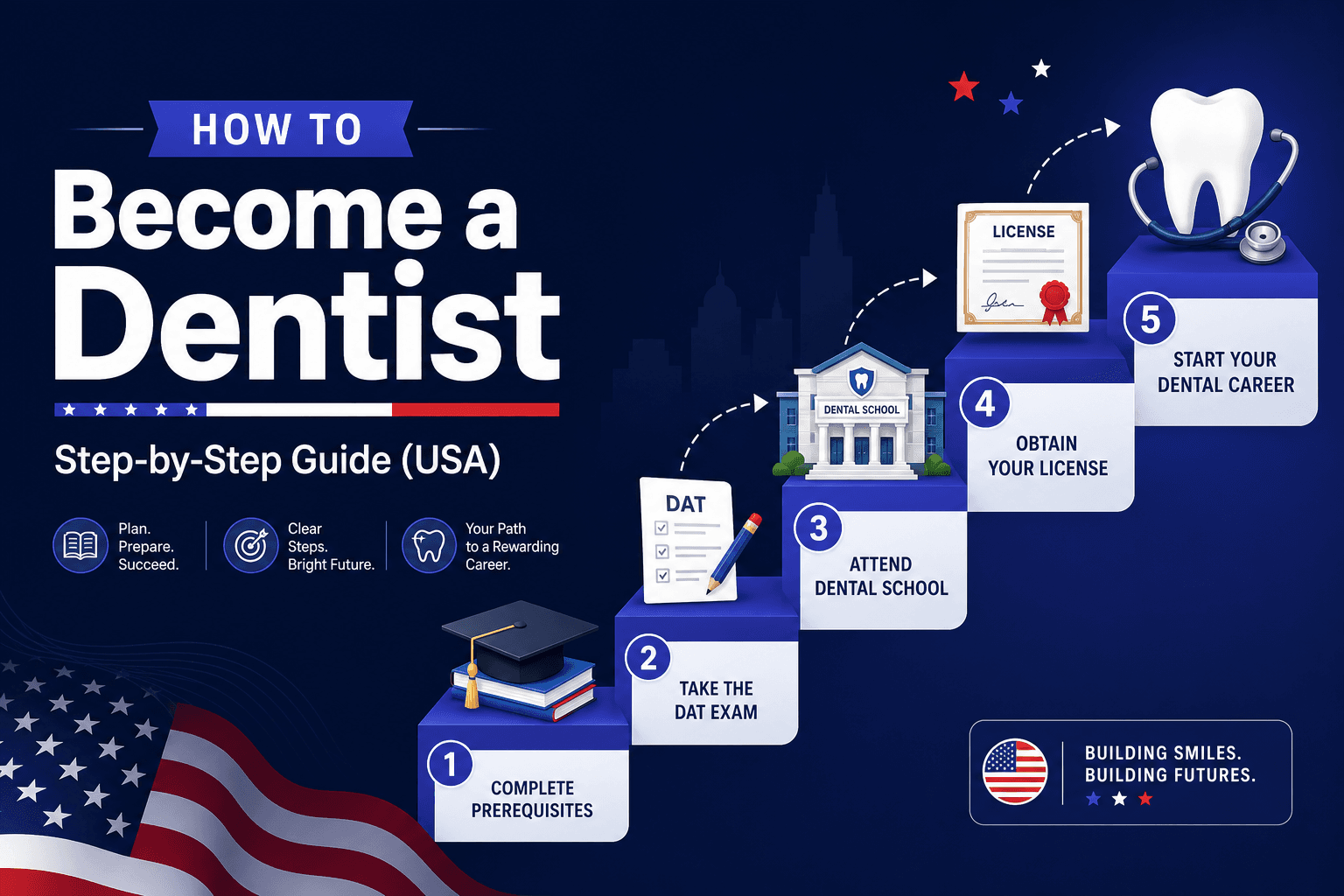

The Path to Becoming a Dentist in the USA
Becoming a dentist in the United States is a long, structured path — usually 8 years after high school (4 years undergraduate + 4 years dental school), followed by licensure and, optionally, specialty training. It is competitive, expensive, and demanding. It is also one of the most rewarding healthcare careers in terms of autonomy, work-life balance, and earning potential.
This guide walks through every step of the journey, in order, so you know exactly what to do and when. Whether you are a high school student, a college freshman, or a career-changer, this is the roadmap.
Step 1: Complete Your Undergraduate Degree and Prerequisites
You do not need a specific major to apply to dental school. You can major in anything — biology, chemistry, engineering, music, business — as long as you complete the prerequisite science courses most dental schools require.
Typical prerequisites:
- Biology with lab (1 year)
- General Chemistry with lab (1 year)
- Organic Chemistry with lab (1 year)
- Physics with lab (1 year)
- Biochemistry (1 semester, increasingly required)
- English / writing (1 year)
- Math (varies — some schools require calculus or statistics)
Most successful applicants major in a science because it overlaps with prerequisites, but admissions committees genuinely do not favor one major over another. What matters is a strong GPA — competitive applicants typically have a 3.5+ overall and science GPA. For a full breakdown, see our guide on dental school GPA requirements and the complete prerequisites list.
Step 2: Gain Dental Experience (Shadowing and More)
Dental schools want proof that you understand the profession. This means shadowing dentists — observing them work across different settings (general practice, specialties, community clinics).
How many hours? Most competitive applicants have 100+ shadowing hours, ideally across general dentistry and at least one specialty. See our detailed guide on how many shadowing hours you need.
Beyond shadowing, strengthen your application with:
- Community service / volunteering (especially health-related)
- Research experience (valued by academic programs)
- Leadership roles
- Manual dexterity activities (art, crafts, playing instruments — dentistry is a hands-on career)
Step 3: Take the DAT (Dental Admission Test)
The DAT is a standardized exam required by nearly all US dental schools. It tests:
- Survey of Natural Sciences (Biology, General Chemistry, Organic Chemistry)
- Perceptual Ability Test (PAT) — spatial reasoning
- Reading Comprehension
- Quantitative Reasoning
Scores range from 1–30, and competitive applicants typically score 20+. Most students study for 3–4 months before taking the exam, usually in their junior year of college.
We have complete section-by-section guides to help you prepare:
- How to Study for the DAT (overall strategy)
- DAT Biology, General Chemistry, Organic Chemistry
- DAT PAT, Quantitative Reasoning, Reading Comprehension
If you are struggling to hit your target score, working with a DAT tutor can significantly accelerate your progress.
Step 4: Apply to Dental School Through AADSAS
US dental school applications go through a centralized service called AADSAS (Associated American Dental Schools Application Service), run by the ADEA. This is where you submit:
- Academic transcripts and GPA
- DAT scores
- Personal statement (4,500-character limit)
- Letters of recommendation
- Activities and experiences
The application cycle opens in early summer (usually late May / early June) for the following year's entering class. Applying early matters enormously because most schools use rolling admissions. See our month-by-month application timeline.
Key application components we cover in depth:
Step 5: Interview at Dental Schools
If your application is competitive, schools will invite you to interview. Formats vary:
- Traditional panel interviews (1–2 interviewers, conversational)
- Multiple Mini Interviews (MMI) — rotating stations with different scenarios
Interviews assess communication, ethics, professionalism, and genuine motivation for dentistry. Prepare with:
- How to prepare for a dental school interview in 2 weeks
- The MMI station-by-station guide
- 30 common interview questions
- How to answer "Why dentistry?"
Step 6: Attend Dental School (4 Years)
US dental school is a 4-year Doctor of Dental Surgery (DDS) or Doctor of Dental Medicine (DMD) program. The two degrees are equivalent — schools simply choose which name to use.
Typical structure:
- Years 1–2: Basic sciences (anatomy, physiology, microbiology, dental materials) plus pre-clinical lab work on models
- Years 3–4: Clinical rotations treating real patients under supervision
During dental school you will also take the Integrated National Board Dental Examination (INBDE), which is required for licensure.
Step 7: Get Licensed
To practice dentistry in the US, you must be licensed in the state where you intend to work. Licensure generally requires:
- 1Graduation from a CODA-accredited dental school
- 2Passing the INBDE (written national board exam)
- 3Passing a clinical licensure exam (regional board exams like ADEX, CDCA, WREB, or a school-based alternative)
- 4Meeting state-specific requirements (background check, jurisprudence exam)
Once licensed, you can practice general dentistry.
Step 8 (Optional): Specialize
General dentists can practice immediately after licensure. But if you want to specialize, you will need additional residency training (2–6 years depending on the specialty). The ADA recognizes 12 dental specialties, including:
- Orthodontics (braces and alignment)
- Oral and Maxillofacial Surgery (the longest and most competitive — 4–6 years)
- Endodontics (root canals)
- Periodontics (gums and implants)
- Pediatric Dentistry
- Prosthodontics
- Oral and Maxillofacial Radiology / Pathology
- Dental Public Health
- Oral Medicine, Orofacial Pain, Anesthesiology
Specialties are competitive and require strong dental school performance and often research.
How Long Does It Take? (Timeline Summary)
| Stage | Duration |
|---|---|
| Undergraduate degree | 4 years |
| Dental school (DDS/DMD) | 4 years |
| Subtotal (general dentist) | ~8 years |
| Optional specialty residency | +2–6 years |
How Much Does It Cost?
Dental school is one of the most expensive graduate programs in the US. Total cost of attendance (tuition + living) commonly ranges from $200,000 to $500,000+ across four years, depending on public vs. private and in-state vs. out-of-state status.
The good news: dentistry has strong earning potential, and there are many ways to manage the cost. See our guide on how to pay for dental school, covering scholarships, federal loans, HPSP military scholarships, and loan forgiveness programs.
What Does a Dentist Earn?
According to the US Bureau of Labor Statistics, dentists earn a strong median income, with general dentists typically earning well into six figures and specialists (especially oral surgeons and orthodontists) earning considerably more. Actual income varies by location, practice ownership, and specialty.
Frequently Asked Questions
Do I need a science major to become a dentist?
No. Any major works as long as you complete the prerequisite courses and maintain a strong GPA.
How competitive is dental school admission?
Very. Overall acceptance rates hover around the range covered in our dental school acceptance rates guide. Strong GPA, DAT, experience, and application materials all matter.
Can international students become dentists in the US?
Yes, but the path differs. Many internationally trained dentists complete an Advanced Standing program (2–3 years) at a US dental school to earn a DDS/DMD and qualify for licensure.
DDS vs DMD — which is better?
Neither. They are equivalent degrees. The school decides which title to award.
What's the fastest way to become a dentist?
The minimum realistic path is 8 years (undergrad + dental school) plus licensure. Some students shorten undergrad slightly with AP credits or accelerated BS/DDS programs, but the core training is fixed.
Your Next Step
Becoming a dentist is a marathon, not a sprint — but every successful dentist started exactly where you are now. The most important thing you can do today is understand the roadmap and start executing on the current step, whether that's raising your GPA, logging shadowing hours, or preparing for the DAT.
If you want expert guidance mapping out your personal path — from DAT prep to application strategy to interviews — schedule a free consultation with Future Dentist Prep. We have helped thousands of pre-dental students turn this roadmap into an acceptance letter.