
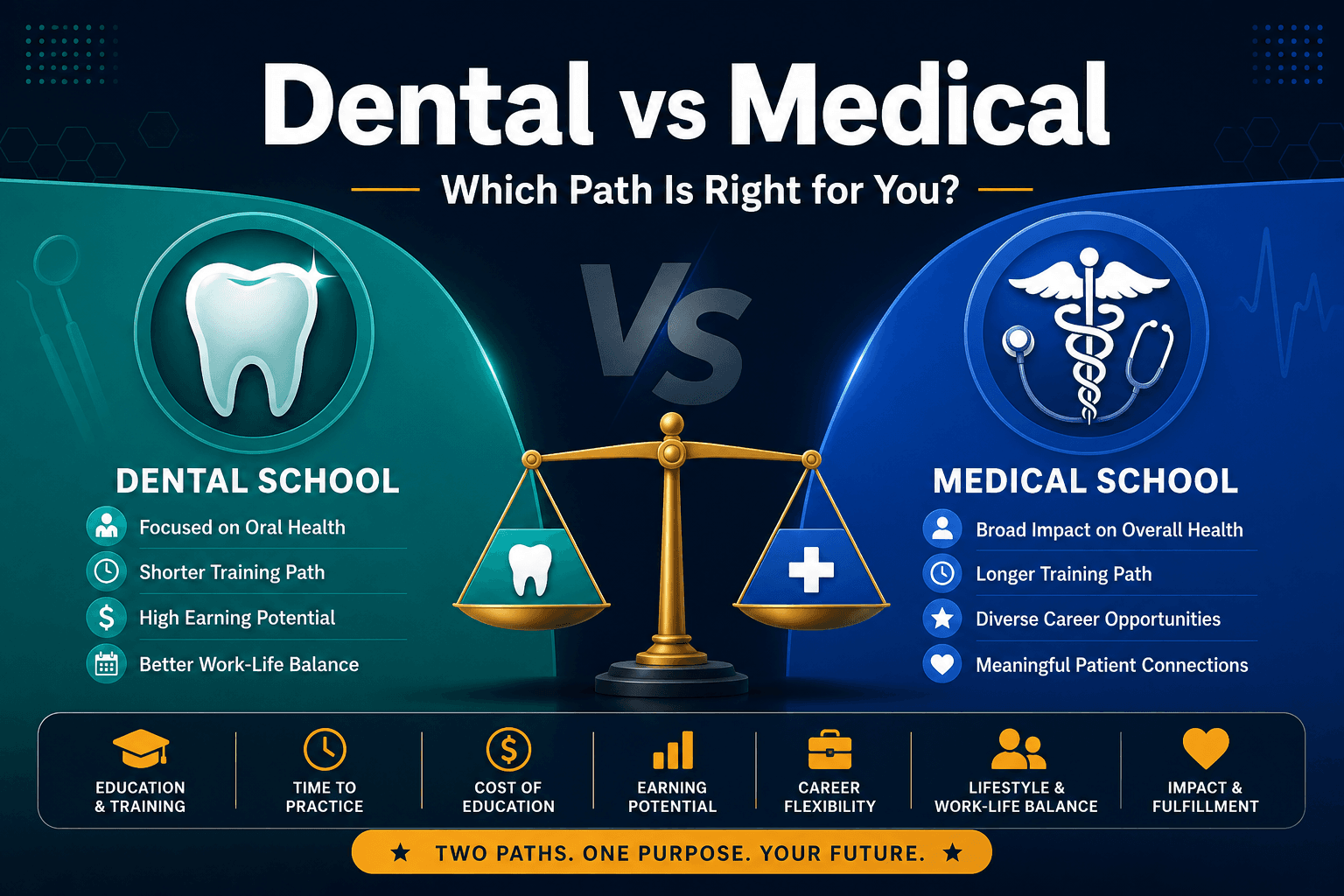

Dental School vs Medical School: The Real Decision
"Should I go to dental school or medical school?" is one of the most common questions pre-health students wrestle with. Both are prestigious, competitive healthcare paths. Both require serious academic ability, years of training, and significant financial investment. But the day-to-day realities — and the reasons to choose one over the other — are very different.
This guide gives you an honest, side-by-side comparison so you can make the decision based on facts and self-knowledge, not assumptions. There is no universally "better" choice — only the one that fits you.
Quick Comparison Table
| Factor | Dental School | Medical School |
|---|---|---|
| Degree | DDS / DMD | MD / DO |
| Length (school) | 4 years | 4 years |
| Residency | Optional (general) or 2–6 yrs (specialty) | Required, 3–7 years |
| Time to practice independently | ~8 years | ~11–15 years |
| Entrance exam | DAT | MCAT |
| Work-life balance | Generally better | Variable, often demanding |
| Practice ownership | Very common | Less common (trend toward employment) |
| Focus | Oral health | Whole-body health |
1. Training Length: Dentistry Is Faster to Practice
This is one of the biggest practical differences.
Dentistry: After 4 years of dental school, you can be licensed and practicing as a general dentist — no residency required. Total: ~8 years after high school.
Medicine: After 4 years of medical school, you must complete a residency (3–7 years depending on specialty) before practicing independently. Total: ~11–15 years after high school.
If practicing sooner and starting to earn a full income earlier matters to you, dentistry has a clear advantage.
2. The Entrance Exams: DAT vs MCAT
DAT (Dental Admission Test):
- Sections: Natural Sciences (Bio, Gen Chem, Orgo), Perceptual Ability (PAT), Reading Comprehension, Quantitative Reasoning
- Notably includes the PAT — a spatial reasoning test unique to dentistry
- Generally considered slightly less broad than the MCAT
- Most students prepare 3–4 months
MCAT (Medical College Admission Test):
- Sections: Biological/Biochemical, Chemical/Physical, Psychological/Social, Critical Analysis (CARS)
- Longer exam (~7.5 hours), broader content including psychology and sociology
- Typically requires 4–6 months of preparation
If you have strong spatial/visual skills, the DAT's PAT may play to your strengths. If you enjoy broad integrative science and reading analysis, the MCAT may suit you. See our DAT study guides if you're leaning dental.
3. The Work Itself: Hands vs. Breadth
This is the heart of the decision — what do you actually want to do all day?
Dentistry is:
- Highly procedural and hands-on — you work with your hands constantly (fillings, crowns, extractions, cleanings)
- Focused on the oral cavity and related structures
- Often immediate — you diagnose and treat a problem in the same visit
- Built on long-term patient relationships in a practice setting
- Requires excellent manual dexterity and fine motor precision
Medicine is:
- Broader — you can work in dozens of fields, from primary care to neurosurgery to psychiatry to radiology
- Often more focused on diagnosis and management of complex, systemic conditions
- More varied in setting (hospital, clinic, ICU, ER, research)
- Can involve higher-acuity, life-or-death situations
- Offers enormous specialty diversity
Ask yourself: Do you want to master a focused, hands-on craft (dentistry), or do you want breadth and the option to work across the entire human body (medicine)?
4. Lifestyle and Work-Life Balance
Dentistry is well known for offering better work-life balance, especially for general dentists:
- More predictable hours (often no overnight call)
- Many dentists work 4-day weeks
- Outpatient setting, rarely emergencies at 3 AM
Medicine varies enormously by specialty. Some fields (dermatology, radiology) offer good balance; others (surgery, OB/GYN, emergency medicine) are demanding with long hours and call. Residency in particular is intense regardless of specialty.
If lifestyle predictability is a top priority, dentistry generally wins.
5. Income and Business Ownership
Both careers offer strong earning potential. A few nuances:
Dentistry:
- General dentists earn strong six-figure incomes
- Practice ownership is very common — many dentists own their practices and earn as business owners, not just clinicians
- Specialists (oral surgeons, orthodontists) are among the highest earners in healthcare
Medicine:
- Wide income range by specialty (primary care lower, procedural specialties much higher)
- Trend toward hospital employment rather than private practice ownership
- Higher ceiling in the top surgical specialties
If entrepreneurship and owning your own business appeals to you, dentistry offers a more accessible path to ownership.
6. Cost of Education
Both are expensive. Dental school total cost of attendance commonly runs $200K–$500K+; medical school is similar or higher. The key difference is timing of earnings — dentists typically start earning a full attending-level income years earlier because they skip the lower-paid residency years.
For managing dental school costs specifically, see how to pay for dental school.
7. Competitiveness of Admission
Both are competitive. Dental school admission requires a strong GPA (typically 3.5+) and a DAT score around 20+. Medical school is also highly competitive with strong GPA and MCAT expectations. Neither is "easy" — see our dental school acceptance rates guide for realistic dental numbers.
How to Actually Decide
Ask yourself these honest questions:
- 1Do I love working with my hands on precise, detailed tasks? → Points to dentistry
- 2Do I want breadth and the option to work across the whole body? → Points to medicine
- 3How important is work-life balance and predictable hours to me? → Dentistry generally offers more
- 4Do I want to practice (and earn) sooner? → Dentistry is faster
- 5Do I want to own my own business? → Dentistry makes this more accessible
- 6Am I drawn to high-acuity, complex, sometimes life-or-death medicine? → Points to medicine
- 7Have I actually shadowed both? → If not, do this before deciding anything
The single most important step: shadow dentists and physicians before you commit. Reading about the difference is not the same as watching the actual work. Most people who shadow both find that one clearly resonates more.
The Bottom Line
Choose dentistry if you want a hands-on, focused craft with excellent work-life balance, a faster path to practice, and strong business-ownership potential.
Choose medicine if you want breadth, the widest range of specialties, and you're drawn to managing complex whole-body health — and you're willing to invest more years in training.
Neither is better. The right choice is the one that matches your personality, your strengths, and the life you want to build.
If you've decided dentistry is your path — or you're leaning that way and want help getting started — schedule a free consultation with Future Dentist Prep. We'll help you build a plan from DAT prep through your acceptance. And if you're still exploring, start with our complete guide on how to become a dentist in the USA.